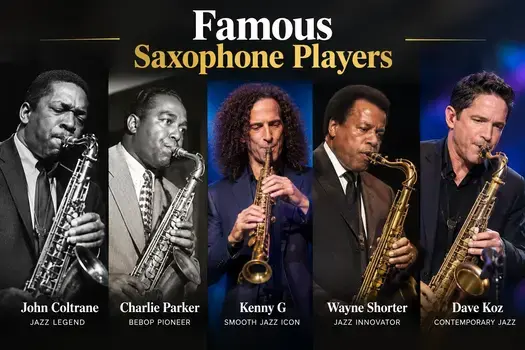
You love the sound of a saxophone but struggle to name the artists behind those unforgettable solos. Skipping these legends means missing decades of brilliance that shaped jazz, blues, and rock. This guide introduces the famous saxophone players who built the soundtrack of modern music and tells you exactly where to start listening.
Who Are the Most Famous Saxophone Players in History?
The saxophone entered the music world in the 1840s when Adolphe Sax patented his invention in Belgium. Within a century, the instrument became the voice of entire musical movements.
Jazz gave the saxophone its soul. Blues gave it grit. Rock gave it volume. Every generation produced artists who pushed the horn further than anyone thought possible.
The famous saxophone players listed below did not just play notes. They rewrote the rules of improvisation, tone, and emotional expression.
| Player | Primary Sax | Era | Genre | Key Contribution |
| Charlie Parker | Alto | 1940s–1950s | Bebop | Invented modern jazz phrasing |
| John Coltrane | Tenor/Soprano | 1950s–1960s | Modal/Free Jazz | Sheets of sound technique |
| Sonny Rollins | Tenor | 1950s–Present | Hard Bop | Thematic improvisation |
| Stan Getz | Tenor | 1940s–1980s | Bossa Nova/Cool | Brought bossa nova to America |
| Coleman Hawkins | Tenor | 1920s–1960s | Swing | First major tenor sax soloist |
| Lester Young | Tenor | 1930s–1950s | Swing/Cool | Light, airy tone pioneer |
| Cannonball Adderley | Alto | 1950s–1970s | Soul Jazz | Blues-drenched alto sound |
| Dexter Gordon | Tenor | 1940s–1980s | Bebop | First bebop tenor voice |
| Wayne Shorter | Tenor/Soprano | 1960s–Present | Post-Bop/Fusion | Complex harmonic composition |
| Michael Brecker | Tenor | 1970s–2000s | Fusion/Pop | Extended technique master |
Source: Smithsonian National Museum of American History – Jazz Archives
What Made Charlie Parker the Father of Bebop Saxophone?
Charlie “Bird” Parker changed everything. Before him, jazz soloists played melodies close to the original tune. Parker shredded that rulebook.
He played blistering tempos, inserted chromatic passing tones, and built solos from chord extensions most musicians ignored. His 1945 recording of “Ko-Ko” remains a masterclass in speed and harmonic daring.
Parker’s alto saxophone tone cut through big bands like a knife. He influenced every famous saxophone player who picked up a horn after 1950.
| Detail | Information |
| Full Name | Charles Parker Jr. |
| Born | August 29, 1920, Kansas City, Kansas |
| Died | March 12, 1955 |
| Signature Horn | King Super 20 Alto |
| Essential Album | The Charlie Parker Story (Savoy) |
| Defining Track | “Ornithology” |
| Technique | Chromatic enclosures, rapid arpeggios |
Why Is John Coltrane Considered the Greatest Saxophonist Ever?
John Coltrane practiced until his lips bled. His dedication produced a sound no one else could replicate.
His 1960 album Giant Steps introduced chord progressions so complex that musicians still study them today. The “Coltrane Changes” became a rite of passage for every serious jazz student.
Coltrane also popularized the soprano saxophone in jazz with his haunting version of “My Favorite Things.” His spiritual period, captured on A Love Supreme, turned the saxophone into a vehicle for prayer.
| Detail | Information |
| Full Name | John William Coltrane |
| Born | September 23, 1926, Hamlet, North Carolina |
| Died | July 17, 1967 |
| Signature Horn | Selmer Mark VI Tenor |
| Essential Album | A Love Supreme (Impulse!) |
| Defining Track | “Giant Steps” |
| Technique | Sheets of sound, multiphonics |
Source: Library of Congress – National Jukebox, Coltrane Recordings
How Did Sonny Rollins Transform Tenor Saxophone Playing?
Sonny Rollins built solos like architects build skyscrapers. He took a single melodic fragment and developed it across dozens of choruses.
His 1957 album Saxophone Colossus features “St. Thomas,” a calypso-inflected tune that became one of the most recorded jazz standards in history. Rollins proved that simplicity and complexity can live inside the same solo.
He famously took two sabbaticals from performing. During the first, he practiced alone on the Williamsburg Bridge in New York City. That image became legendary.
| Detail | Information |
| Full Name | Theodore Walter Rollins |
| Born | September 7, 1930, New York City |
| Status | Retired (2012) |
| Signature Horn | Selmer Mark VI Tenor |
| Essential Album | Saxophone Colossus (Prestige) |
| Defining Track | “St. Thomas” |
| Technique | Thematic development, rhythmic displacement |
What Makes Stan Getz the King of Bossa Nova Saxophone?
Stan Getz played with a warm, breathy tone that sounded like velvet. His cool jazz style made him a star in the 1950s.
Then he traveled to Brazil. His 1964 collaboration with João Gilberto and Antônio Carlos Jobim produced “The Girl from Ipanema,” one of the best-selling jazz singles ever recorded.
Getz proved that the saxophone could whisper. His soft dynamics opened doors for smooth jazz and crossover audiences worldwide.
| Detail | Information |
| Full Name | Stanley Gayetzky |
| Born | February 2, 1927, Philadelphia |
| Died | June 6, 1991 |
| Signature Horn | Selmer Mark VI Tenor |
| Essential Album | Getz/Gilberto (Verve) |
| Defining Track | “The Girl from Ipanema” |
| Technique | Subtone, lyrical phrasing |
Which Famous Saxophone Players Dominated the Blues Scene?
The blues needed a voice that could cry, shout, and moan. The saxophone filled that role perfectly.
King Curtis brought a honking, aggressive tenor sound to rhythm and blues. His solo on “Yakety Yak” by The Coasters became one of the most recognizable sax lines in pop history.
Junior Walker took the same energy into Motown. His gritty alto work on “Shotgun” proved that the saxophone could drive a dance floor just as hard as any guitar.
| Player | Sax Type | Era | Signature Track | Label |
| King Curtis | Tenor | 1950s–1970s | “Soul Serenade” | Atlantic |
| Junior Walker | Tenor | 1960s–1970s | “Shotgun” | Motown |
| Louis Jordan | Alto | 1930s–1950s | “Caldonia” | Decca |
| Big Jay McNeely | Tenor | 1940s–1950s | “The Deacon’s Hop” | Savoy |
| Lee Allen | Tenor | 1950s–1960s | “Walking with Mr. Lee” | Specialty |
Who Are the Best Female Saxophone Players of All Time?
Women have shaped the saxophone world since its earliest days, though history often overlooked their contributions.
Vi Burnside played tenor sax with the International Sweethearts of Rhythm during the 1940s. She delivered powerful solos in an era when all-female bands faced constant discrimination.
Candy Dulfer exploded onto the scene in 1989 with “Lily Was Here,” a smooth jazz hit that reached number one across Europe. She continues to tour and record with an energetic funk style.
| Player | Sax Type | Era | Notable Achievement |
| Vi Burnside | Tenor | 1940s | International Sweethearts of Rhythm |
| Candy Dulfer | Alto | 1980s–Present | Grammy-nominated, global hits |
| Tia Fuller | Alto/Soprano | 2000s–Present | Beyoncé’s touring band, Berklee professor |
| Lakecia Benjamin | Alto | 2010s–Present | 2024 Grammy winner |
| Jessy J | Tenor | 2000s–Present | Smooth Jazz chart-topper |
| Melissa Aldana | Tenor | 2010s–Present | Thelonious Monk Competition winner |
What Role Did Famous Saxophone Players Have in Rock Music?
Rock and roll borrowed the saxophone from rhythm and blues. Early rock records featured sax solos more often than guitar solos.
Clarence Clemons gave Bruce Springsteen’s E Street Band its thunderous heart. His tenor solo on “Jungleland” remains one of the most emotional moments in rock history.
Raphael Ravenscroft played the iconic alto line on Gerry Rafferty’s “Baker Street.” That eight-bar intro became more famous than most full songs.
| Player | Rock Act | Sax Type | Iconic Track |
| Clarence Clemons | Bruce Springsteen | Tenor | “Jungleland” |
| Raphael Ravenscroft | Gerry Rafferty | Alto | “Baker Street” |
| Bobby Keys | The Rolling Stones | Tenor | “Brown Sugar” |
| Dick Parry | Pink Floyd | Tenor/Baritone | “Money” |
| Edgar Winter | Edgar Winter Group | Alto | “Frankenstein” |
How Do Modern Famous Saxophone Players Compare to Jazz Legends?
Today’s saxophonists stand on the shoulders of giants and reach even higher. They absorb the entire history of the instrument and blend it with hip-hop, electronic music, and global rhythms.
Kamasi Washington brought the tenor saxophone back to mainstream attention with his 2015 triple album The Epic. He fills arenas, a rare feat for a jazz musician.
Chris Potter pushes technical boundaries with circular breathing and harmonic overtones. His command of all four saxophone voices makes him one of the most versatile players alive.
| Modern Player | Sax Type | Style Fusion | Breakthrough Album |
| Kamasi Washington | Tenor | Jazz/Hip-Hop | The Epic (2015) |
| Chris Potter | Tenor/Soprano | Post-Bop/Electronic | The Dreamer Is the Dream (2017) |
| Kenny Garrett | Alto | Post-Bop/Funk | Pushing the World Away (2013) |
| Joshua Redman | Tenor | Modern Mainstream | Still Dreaming (2018) |
| Immanuel Wilkins | Alto | Avant-Garde/Spiritual | The 7th Hand (2022) |
What Instruments Did These Famous Saxophone Players Prefer?
The Selmer Mark VI dominates the list. Manufactured in Paris from 1954 to 1974, this horn set the gold standard for professional saxophones.
Coltrane, Rollins, Getz, and Dexter Gordon all played Mark VIs at various points. The horn’s warm core tone and flexible response suited every style from bebop to free jazz.
Charlie Parker preferred the King Super 20, which produced a brighter, more cutting sound ideal for his rapid-fire lines.
| Saxophone Model | Manufacturer | Era | Famous Users |
| Mark VI | Selmer Paris | 1954–1974 | Coltrane, Rollins, Getz |
| Super 20 | King | 1940s–1960s | Parker, Cannonball Adderley |
| Balanced Action | Selmer Paris | 1936–1954 | Coleman Hawkins |
| Custom EX | Yamaha | 2000s–Present | Chris Potter, Tia Fuller |
| Reference 54 | Selmer Paris | 2001–Present | Joshua Redman |
Where Can You Hear the Best Saxophone Performances Today?
Live jazz clubs remain the best place to experience the saxophone up close. The Village Vanguard in New York City has hosted every major saxophonist since 1935.
Ronnie Scott’s in London and the Blue Note in Tokyo offer world-class programming year-round. Streaming platforms also carry thousands of live recordings from legendary performances.
The Recording Academy’s Grammy Archives provide access to award-winning saxophone performances spanning seven decades.
How Can Beginners Learn from Famous Saxophone Players?
Start by listening. Pick one recording from Charlie Parker and one from Stan Getz. Notice how their approaches to rhythm, tone, and phrasing differ completely.
Transcribe short solos by ear. Even four bars of Cannonball Adderley will teach you more about blues phrasing than a year of scale exercises.
Find a local teacher who emphasizes listening alongside technique. The famous saxophone players you admire all learned by copying their heroes before finding their own voice.
Detailed Comparison of All 20 Famous Saxophone Players
| # | Player | Sax | Birth Year | Genre | Key Album | Signature Technique |
| 1 | Charlie Parker | Alto | 1920 | Bebop | The Charlie Parker Story | Chromatic enclosures |
| 2 | John Coltrane | Tenor | 1926 | Modal Jazz | A Love Supreme | Sheets of sound |
| 3 | Sonny Rollins | Tenor | 1930 | Hard Bop | Saxophone Colossus | Thematic development |
| 4 | Stan Getz | Tenor | 1927 | Bossa Nova | Getz/Gilberto | Subtone warmth |
| 5 | Coleman Hawkins | Tenor | 1904 | Swing | Body and Soul | Arpeggiated lines |
| 6 | Lester Young | Tenor | 1909 | Cool Jazz | The Complete Savoy | Light, floating tone |
| 7 | Cannonball Adderley | Alto | 1928 | Soul Jazz | Somethin’ Else | Blues inflection |
| 8 | Dexter Gordon | Tenor | 1923 | Bebop | Go! | Behind-the-beat phrasing |
| 9 | Wayne Shorter | Tenor | 1933 | Post-Bop | Speak No Evil | Angular composition |
| 10 | Michael Brecker | Tenor | 1949 | Fusion | Michael Brecker | Extended harmonics |
| 11 | King Curtis | Tenor | 1934 | R&B | Soul Serenade | Honking growl |
| 12 | Clarence Clemons | Tenor | 1942 | Rock | Born to Run | Power ballad tone |
| 13 | Candy Dulfer | Alto | 1969 | Funk/Pop | Saxuality | Funk articulation |
| 14 | Kamasi Washington | Tenor | 1981 | Modern Jazz | The Epic | Spiritual intensity |
| 15 | Kenny Garrett | Alto | 1960 | Post-Bop | Pushing the World Away | Vocal-like cry |
| 16 | David Sanborn | Alto | 1945 | Smooth Jazz | Voyeur | Bright, edgy altissimo |
| 17 | Ornette Coleman | Alto | 1930 | Free Jazz | The Shape of Jazz | Harmolodic theory |
| 18 | Joe Henderson | Tenor | 1937 | Post-Bop | Page One | Intervallic leaps |
| 19 | Ben Webster | Tenor | 1909 | Swing | Soulville | Breath-heavy vibrato |
| 20 | Sidney Bechet | Soprano | 1897 | Early Jazz | The Blue Note Sessions | Wide, operatic vibrat |
Frequently Asked Questions About Famous Saxophone Players
Who is the most famous saxophone player in the world?
John Coltrane holds that title for most musicians and critics. His technical mastery, spiritual depth, and harmonic innovations set a standard that no other saxophonist has surpassed.
What kind of saxophone is ideal for novices?
The alto saxophone works best for most beginners. It weighs less than a tenor, requires less air, and costs less to buy. Most school band programs start students on alto.
Who invented the saxophone?
The saxophone was patented in 1846 by Belgian instrument manufacturer Adolphe Sax.He designed it to bridge the gap between brass projection and woodwind agility.
Which famous saxophone players played alto sax?
Charlie Parker, Cannonball Adderley, Ornette Coleman, Kenny Garrett, and Candy Dulfer all built their careers on the alto saxophone.
How long does it take to play saxophone like a professional?
Most professionals practice seriously for 10 to 15 years before reaching a high level. Consistent daily practice of two to four hours accelerates progress significantly.
Are there famous saxophone players in pop music?
Yes. David Sanborn played on hundreds of pop records. Kenny G sold over 75 million albums. Raphael Ravenscroft’s “Baker Street” solo remains one of pop’s most recognizable hooks.
Pick Up a Horn and Start Listening TodayWhat type of saxophone is best for beginners?
The famous saxophone players in this guide did not wait for permission to create. They listened, practiced, and poured their lives into every note.
Your next step is simple. Choose one album from the tables above. Put on headphones. Close your eyes. Let the sound of a Selmer Mark VI or a King Super 20 wash over you.
Then find a local music store, rent an alto saxophone, and play your first note. The tradition these legends built is waiting for your voice.