Quick Summary / Key Takeaways
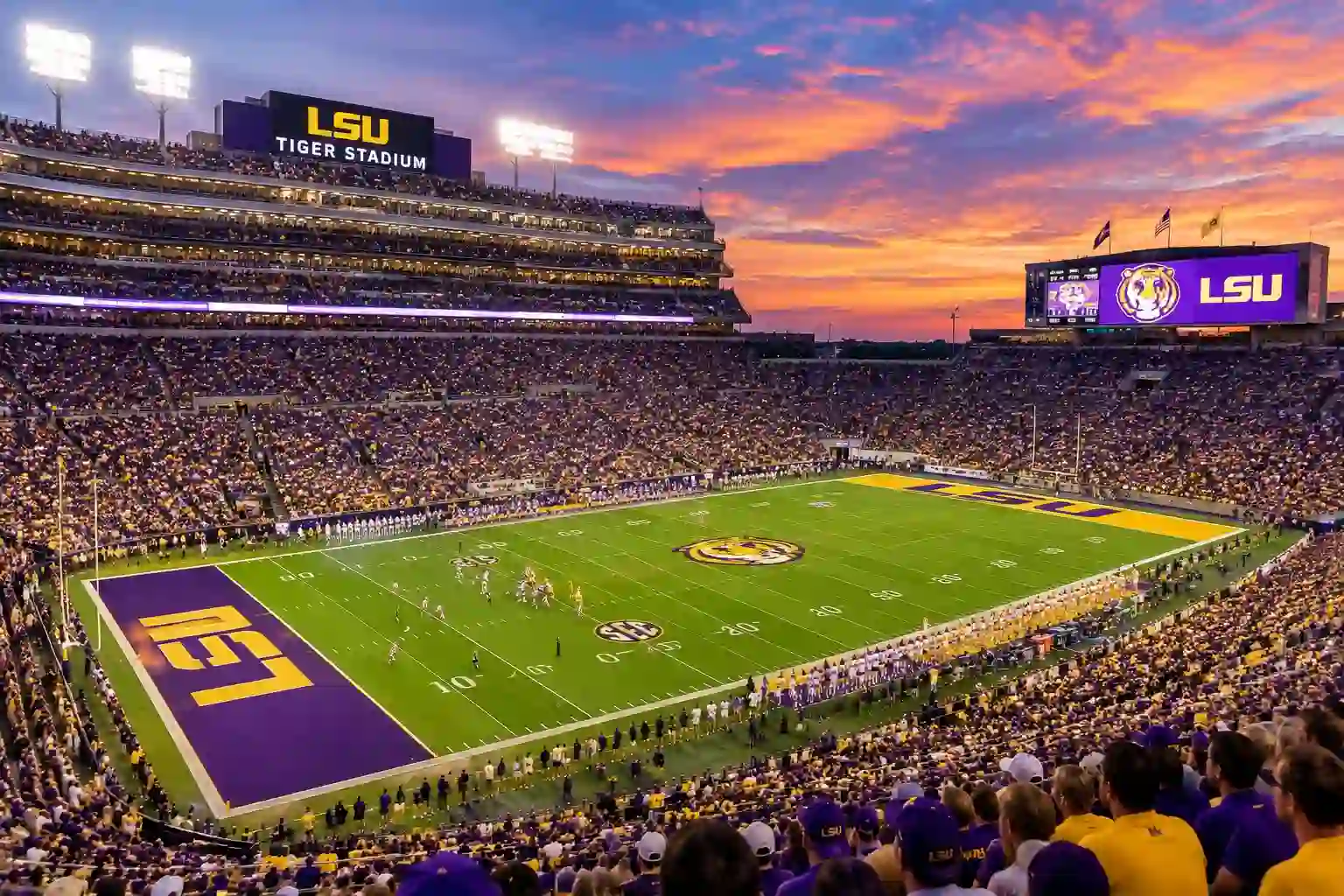
- Tiger Stadium, nicknamed “Death Valley,” is the home of the LSU Tigers football program in Baton Rouge, Louisiana.
- Current seating capacity stands at 102,321, making it one of the largest stadiums in the NCAA and the world.
- The LSU football stadium seating chart spans four primary zones: North End Zone, South End Zone, East Upper Deck, and West Upper Deck.
- Game-day decibel levels have been recorded above 130 dB, rivaling NFL venues and jet engines at takeoff.
- Major renovations in 2014 (South End Zone) and ongoing facility upgrades keep the stadium competitive with SEC rivals.
Direct Answer Block
LSU football stadium, officially named Tiger Stadium and widely known as Death Valley, is a 102,321-seat college football venue located on the LSU campus in Baton Rouge, Louisiana. Opened in 1924, it is one of the largest and loudest stadiums in NCAA Division I FBS football and the home field of the SEC’s LSU Tigers.
Introduction
There are stadiums that host football games, and then there are stadiums that become the game. LSU football stadium belongs firmly in the second category. When 102,321 fans packed into Tiger Stadium start screaming on a Saturday night in Baton Rouge, the concrete literally vibrates beneath your feet. Visiting quarterbacks can’t hear snap counts. Kickers miss field goals they’d nail in practice. The ESPN broadcast crew struggles to communicate through headsets.
This isn’t hyperbole — it’s measurable acoustics and decades of documented on-field chaos.
Whether you’re a die-hard LSU fan planning your first pilgrimage to Death Valley, a casual college football viewer curious about the hype, or an athlete preparing to compete in one of the most hostile environments in American sports, this guide breaks down everything you need to know. From the LSU football stadium seating chart to the tactical impact of crowd noise on SEC matchups, we’re going deep on the venue that Sports Illustrated once called the best in college football.
The History and Evolution of Tiger Stadium (H2)
From 12,000 Seats to 102,000+ (H3)
Tiger Stadium opened in 1924 with a modest capacity of approximately 12,000 spectators. The original structure was a single lower grandstand on the west side of the field. Over the next century, LSU athletics invested in a series of aggressive expansions that transformed the venue into a modern mega-stadium.
Key expansion milestones include the 1978 East Upper Deck addition (pushing capacity past 75,000), the 1994 West Upper Deck project, and the landmark 2014 South End Zone expansion, which added roughly 22,000 seats and brought the total to its current 102,321 figure. Each phase was funded through a combination of private donations, bond issues, and SEC revenue sharing — a financial model that mirrors how programs like Alabama (Bryant-Denny Stadium) and Texas A&M (Kyle Field) have scaled their own facilities.
Why “Death Valley”? (H3)
The nickname Death Valley originated in the late 1950s, drawing a parallel to Clemson’s Memorial Stadium (which shares the same moniker). However, LSU fans argue their version earned the name through sheer acoustic brutality. The stadium’s U-shaped bowl design traps and amplifies sound, creating a reverberation effect that makes crowd noise exponentially more punishing than in open-air or dome configurations.
LSU Football Stadium Seating Chart Breakdown (H2)
Understanding the LSU football stadium seating chart is critical for fans choosing tickets and for analysts evaluating home-field advantage distribution across the venue.
Primary Seating Zones (H3)
Tiger Stadium is divided into four major seating sections, each offering a distinct sightline and atmosphere:
- North End Zone: Student section territory. This is where the LSU band and the most vocal student supporters create the epicenter of game-day noise. Tickets here are rarely available to the general public.
- South End Zone: The newest premium section, added during the 2014 expansion. Features club seating, luxury suites, and the Tiger Athletic Foundation (TAF) donor areas. Sightlines are elevated and panoramic.
- East Upper Deck: A mix of general admission and reserved seating. The upper rows provide a bird’s-eye tactical view ideal for watching offensive formations and defensive rotations.
- West Upper Deck: The original grandstand side, housing the press box and broadcast booths. Lower rows here offer the closest proximity to the visiting team’s sideline — a deliberate design choice that maximizes crowd intimidation.
Seating Comparison Table (H3)
| Seating Zone | Approx. Capacity | Price Range (Single Game) | Best For | Atmosphere Rating |
|---|---|---|---|---|
| North End Zone | ~15,000 | Student / N/A | Die-hard fans, students | ⭐⭐⭐⭐⭐ |
| South End Zone | ~22,000 | $150–$500+ | Premium experience, donors | ⭐⭐⭐⭐ |
| East Upper Deck | ~28,000 | $60–$200 | Tactical viewing, families | ⭐⭐⭐⭐ |
| West Upper Deck | ~37,000 | $50–$300 | Classic sightlines, media | ⭐⭐⭐⭐ |
[Link: Relevant internal article — LSU Football Season Ticket Pricing Guide]
Expert Sports Analysis: How Death Valley Impacts On-Field Performance (H2)
The Decibel Advantage in SEC Play (H3)
Home-field advantage is a real, quantifiable phenomenon in college football, and LSU football stadium consistently ranks at the top of the metric. A 2019 study by The Athletic measured average game-day noise levels at Tiger Stadium at 118–130 dB during critical third-down situations. For context, sustained exposure above 120 dB causes physical pain in the human ear.
From a tactical standpoint, this noise creates three measurable disruptions for visiting offenses:
- Pre-snap communication breakdown: Quarterbacks cannot audible at the line, forcing offenses into simplified play calls.
- False start penalties: LSU opponents average 1.4 more false starts per game in Baton Rouge compared to their season averages, according to SEC officiating data.
- Clock management errors: Visiting coaches burn timeouts simply to regroup huddles, leaving them short in critical fourth-quarter situations.
Comparative SEC Stadium Analysis (H3)
| Stadium | Team | Capacity | Avg. Attendance (2023) | Notable Noise Record |
|---|---|---|---|---|
| Tiger Stadium | LSU | 102,321 | 101,700+ | 130 dB (2003 vs. Auburn) |
| Bryant-Denny Stadium | Alabama | 100,077 | 101,821 | 125 dB (est.) |
| Kyle Field | Texas A&M | 102,733 | 103,000+ | 131 dB (2014 vs. Ole Miss) |
| Neyland Stadium | Tennessee | 101,915 | 101,500+ | 128 dB (est.) |
| Sanford Stadium | Georgia | 92,746 | 92,500+ | 124 dB (est.) |
[Link: External source — NCAA FBS Stadium Capacity Rankings]
The data shows that Tiger Stadium is firmly in the elite tier of SEC venues, competing directly with Kyle Field and Bryant-Denny for the title of the most intimidating environment in the conference.
Common Pitfalls & Strategic Mistakes (H2)
For Fans (H3)
- Ignoring the LSU football stadium seating chart before purchasing: Many first-time visitors buy upper-deck seats expecting sideline proximity and end up 80 feet above the field. Study the seating chart carefully and prioritize lower-bowl sections for the authentic Death Valley experience.
- Underestimating game-day logistics: Baton Rouge traffic on LSU game days is notoriously congested. Arrive at least three hours before kickoff and use designated park-and-ride shuttles from the LSU campus lots.
- Skipping hydration planning: Louisiana humidity in September and October regularly exceeds 80%. Heat exhaustion is a genuine risk in the upper deck, where shade is minimal.
For Visiting Teams (H3)
- Failing to simulate crowd noise in practice: Teams that don’t run silent-count drills at 120+ dB during the week leading up to a Baton Rouge game consistently struggle with snap timing.
- Over-relying on the passing game in early downs: The noise disruption disproportionately affects complex route adjustments. Successful visitors (e.g., Florida’s 2021 upset) leaned heavily on the run game to control tempo and limit third-and-long situations where crowd noise peaks.
Frequently Asked Questions (H2)
What is the official name of LSU football stadium? (H3)
The official name is Tiger Stadium, located on the campus of Louisiana State University in Baton Rouge. It is universally nicknamed Death Valley due to its deafening game-day atmosphere and the difficulty visiting teams face when playing there.
How many seats does LSU football stadium have? (H3)
Tiger Stadium has a current capacity of 102,321, making it the seventh-largest stadium in the United States and one of the largest in the world. Capacity has grown steadily since the venue opened in 1924.
Where can I find the LSU football stadium seating chart? (H3)
The official LSU football stadium seating chart is available on the LSU Athletics website (LSUsports.net) and through the Tiger Athletic Foundation (TAF) ticket portal. Interactive 3D seat views are also offered through third-party vendors like SeatGeek.
Why is Tiger Stadium called Death Valley? (H3)
The nickname dates to the late 1950s and reflects the stadium’s reputation for being nearly impossible for visiting teams to win in. The bowl-shaped design amplifies crowd noise to extreme levels, creating a “valley of death” for opponents.
What is the largest crowd ever at LSU football stadium? (H3)
The record attendance at Tiger Stadium is 102,321, set during multiple sold-out SEC matchups since the 2014 South End Zone expansion was completed. The venue regularly sells out for rivalry games against Alabama, Florida, and Ole Miss.
Is LSU football stadium the loudest in college football? (H3)
Tiger Stadium is consistently ranked among the top three loudest college football stadiums, alongside Kyle Field (Texas A&M) and Husky Stadium (Washington). Measured decibel readings have exceeded 130 dB during peak moments.
Can I tour LSU football stadium on non-game days? (H3)
Yes. LSU Athletics offers guided stadium tours year-round through the LSU Sports Hall of Fame. Tours include access to the field, locker rooms, press box, and the South End Zone premium areas. Advance booking is recommended.
Conclusion
LSU football stadium isn’t just a venue — it’s a competitive weapon, a cultural landmark, and one of the last truly overwhelming home-field advantages in American sports. From the 102,321-seat capacity to the bone-rattling acoustics of Death Valley on a Saturday night, Tiger Stadium delivers an experience that no broadcast can fully capture.
Whether you’re studying the LSU football stadium seating chart to plan your first visit, analyzing how crowd noise skews SEC win probabilities, or simply marveling at a century of football history built into Louisiana concrete, the data and the decibels tell the same story: there is no place quite like this.