Quick Summary / Key Takeaways
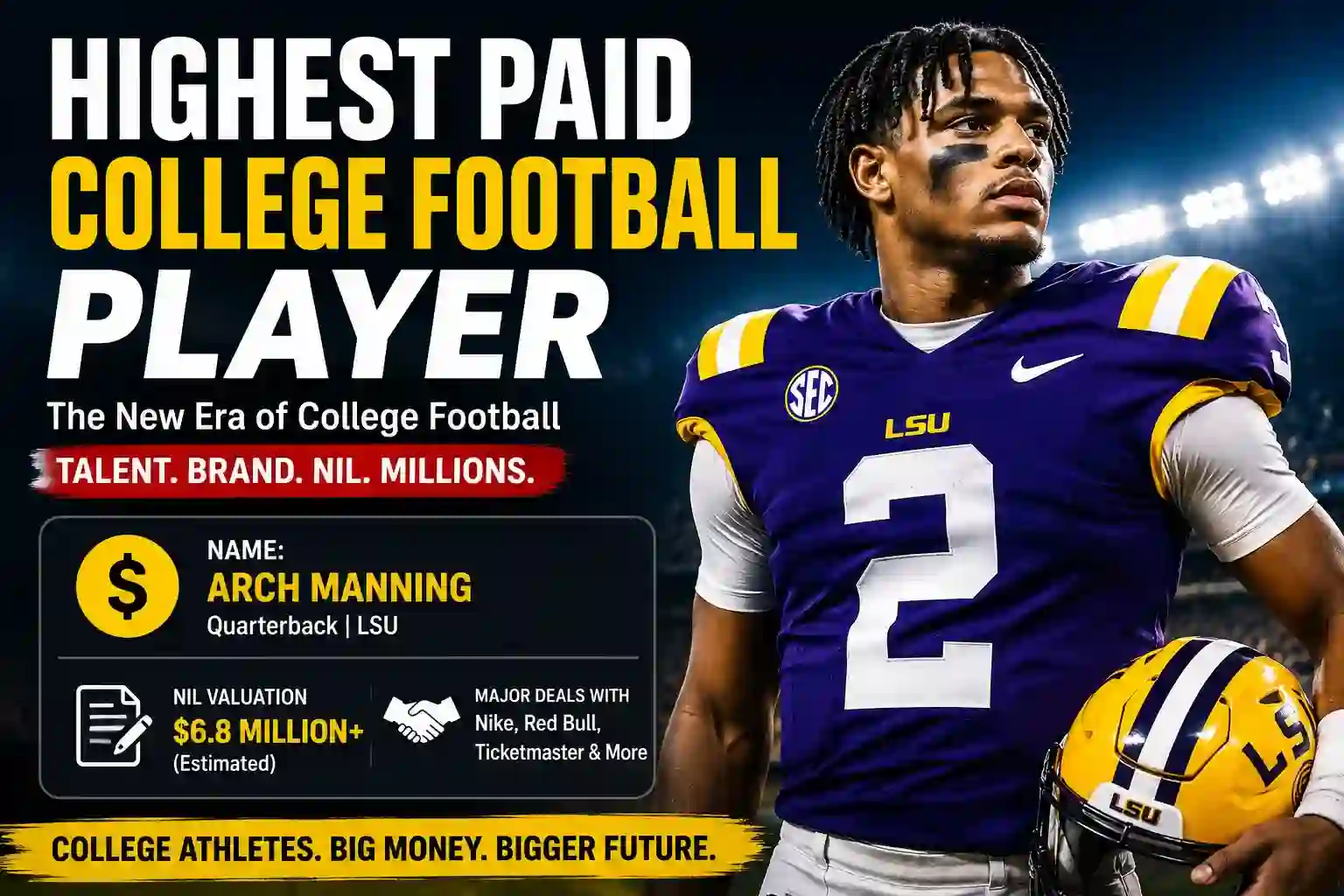
- Arch Manning is the highest paid college football player in 2025, with estimated NIL earnings of $6–8 million annually.
- The NIL era exploded after the NCAA’s July 2021 policy shift, allowing athletes to monetize their name, image, and likeness.
- The House v. NCAA settlement introduces direct revenue sharing starting in the 2025–26 season, fundamentally changing college athlete compensation.
- Top NIL earners now rival entry-level professional contracts in some cases.
- Quarterbacks and dual-threat athletes dominate the highest tiers of NIL valuation.
Direct Answer
Who is the highest paid college football player? Arch Manning, the Texas Longhorns quarterback, is the highest paid college football player in 2025. His NIL portfolio—featuring deals with brands like Bose, EA Sports, and Raising Cane’s—is estimated at $6–8 million per year, making him the most marketable athlete in college football.
Introduction
The college football landscape has been unrecognizable since the NIL era kicked off in July 2021. Gone are the days when amateurism rules kept elite athletes from earning a dime off their own jersey sales. Now, the question fans, recruits, and analysts ask every offseason is simple: who is the highest paid college football player?
The answer in 2025 points squarely to Arch Manning, the Texas Longhorns signal-caller and nephew of NFL legends Peyton and Eli Manning. But the story behind that number is far more complex than a single dollar figure. NIL collectives, brand endorsements, the impending House v. NCAA revenue-sharing model, and the sheer gravitational pull of the quarterback position all converge to create a compensation ecosystem that would have been unthinkable five years ago.
This breakdown covers the top earners, the mechanics of NIL deals, and what the future of college football pay looks like as the sport enters its most transformative financial era yet.
The Rise of Arch Manning: Why He’s the Highest Paid College Football Player
Arch Manning didn’t just inherit a famous last name—he inherited a marketing machine. The five-star recruit from Isidore Newman School in New Orleans committed to Texas in December 2022, and his NIL valuation skyrocketed before he ever took a meaningful snap for the Longhorns.
By the 2024–25 cycle, Manning’s estimated NIL earnings reached $6–8 million annually, according to On3 Sports’ NIL Valuation index. His deal portfolio includes:
- Bose (audio equipment)
- EA Sports (college football video game likeness)
- Raising Cane’s (restaurant chain)
- Degree Deodorant
- Panini America (trading cards)
What separates Manning from other top earners is the combination of on-field production potential, generational brand recognition, and market size. Texas athletics generated over $238 million in revenue during the 2023–24 fiscal year, giving Longhorn NIL collectives like The Collective enormous fundraising leverage.
[Link: Relevant internal article on Arch Manning’s 2025 season preview]
How NIL Deals Work in College Football
If you’re asking what is the highest paid college football player earning and how, you need to understand the NIL framework.
Name, Image, and Likeness (NIL) compensation comes from three primary sources:
- Brand Endorsements: Direct contracts between athletes and companies (e.g., Manning’s Bose deal).
- NIL Collectives: Donor-funded organizations that pool money to offer athletes compensation for promotional activities, autograph signings, and community appearances.
- Social Media & Content Deals: Athletes with large followings monetize posts, YouTube content, and podcast appearances.
Crucially, NIL money is not a salary from the university. NCAA rules still prohibit schools from directly paying athletes for athletic performance. However, the House v. NCAA settlement, approved in 2025, changes that calculus dramatically by allowing schools to share up to $20.5 million annually in revenue directly with athletes starting in the 2025–26 academic year.
This means the distinction between “NIL earnings” and “school compensation” is about to blur significantly.
[Link: External source – NCAA official NIL policy guidelines]
Top 5 Highest Paid College Football Players by NIL Valuation (2025)
The race for the top spot is competitive, but quarterbacks dominate the upper echelon. Here’s how the highest paid college football player NIL rankings shake out:
| Rank | Player | School | Position | Est. NIL Valuation | Key Deals |
|---|---|---|---|---|---|
| 1 | Arch Manning | Texas | QB | $6–8M | Bose, EA Sports, Raising Cane’s |
| 2 | Garrett Nussmeier | LSU | QB | $3–4.5M | Raising Cane’s, Walk-On’s |
| 3 | Jeremiah Smith | Ohio State | WR | $2.5–4M | Nike, JBL, Wendy’s |
| 4 | DJ Lagway | Florida | QB | $2–3.5M | Gatorade, Bose |
| 5 | Ryan Williams | Alabama | WR | $1.8–3M | Nike, Beats by Dre |
Note: NIL valuations are estimates based on On3 Sports, 247Sports, and Opendorse data. Actual contract figures are private.
What stands out? The quarterback premium is real. Three of the top five are QBs, reflecting both positional value and the marketing appeal of the player who touches the ball every offensive snap. Jeremiah Smith and Ryan Williams break that trend as generational wide receiver talents who went viral as true freshmen.
The House v. NCAA Settlement: A New Era of Athlete Pay
Understanding who’s the highest paid college football player in 2025 requires context about what’s coming in 2026 and beyond.
The House v. NCAA settlement is the most consequential legal development in college sports history. Key provisions include:
- $2.78 billion in back-pay damages to former athletes.
- Revenue sharing of up to ~$20.5 million per school per year, distributed directly to athletes.
- Roster limits replacing scholarship caps (e.g., 105 players for FBS football).
- Elimination of the NCAA’s enforcement role in NIL deal policing.
For the highest paid college football player NIL earners, this means their total compensation could soon include both private NIL deals and a direct cut of conference TV revenue. A quarterback at a Power Four school could realistically earn $10–15 million annually within two to three years when combining both streams.
This fundamentally restructures recruiting. Coaches will function more like general managers, negotiating compensation packages rather than selling campus culture alone.
[Link: External source – ESPN coverage of House v. NCAA settlement details]
Expert Analysis: What the Numbers Mean for College Football
From an analytical standpoint, the NIL compensation curve mirrors professional sports economics more closely than anyone anticipated. A few key observations:
Positional value drives pay. Just as NFL quarterbacks command 15–20% of the salary cap, college QBs dominate NIL rankings. The market correctly prices the most impactful position.
Market size matters enormously. Athletes at Texas, Ohio State, Alabama, and LSU have structural advantages over equally talented players at smaller programs. A five-star recruit at a Group of Five school will almost never match the NIL valuation of a three-star at a blue-blood program.
The transfer portal is a free-agency market. Players now leverage portal entries to renegotiate NIL deals, functioning identically to NFL free agency. The highest paid college football player title could shift mid-season if a top earner transfers to a wealthier program.
Brand longevity vs. flash-in-the-pan virality. Manning’s deals are structured for multi-year value. Players who spike in NIL valuation after a single viral highlight often see sharp corrections the following cycle.
Common Pitfalls in Evaluating College Football NIL Earnings
Fans and analysts frequently misinterpret NIL data. Here are the most common mistakes:
- Confusing valuation with actual earnings. On3 and 247Sports publish estimated valuations, not audited contract figures. The real number could be 30–50% lower or higher.
- Ignoring deal structure. A “$5 million deal” might be spread over four years with performance incentives, not a lump-sum payment.
- Overlooking state NIL laws. States like Texas, Florida, and Tennessee have more permissive NIL legislation than others, creating uneven playing fields.
- Assuming NIL equals take-home pay. Federal and state taxes, agent fees (typically 10–20%), and collective overhead significantly reduce net income.
Frequently Asked Questions
Who is the highest paid college football player in 2025?
Arch Manning of the Texas Longhorns is the highest paid college football player in 2025, with estimated NIL earnings between $6–8 million annually from deals with Bose, EA Sports, Raising Cane’s, and others.
Who’s the highest paid college football player by NIL deals alone?
Arch Manning leads all college football players in pure NIL deal value. His combination of brand endorsements and collective compensation places him at the top of every major NIL valuation index.
What is the highest paid college football player earning per year?
The highest paid college football player earns an estimated $6–8 million per year through NIL agreements. This figure could increase significantly once House v. NCAA revenue sharing begins in 2025–26.
What’s the highest paid college football player position?
Quarterback is consistently the highest paid position in college football NIL. Three of the top five NIL earners in 2025 are quarterbacks, reflecting both on-field impact and marketing appeal.
Who is highest paid college football player after the NFL Draft departures?
With Shedeur Sanders and Travis Hunter declaring for the 2025 NFL Draft, Arch Manning inherited the top spot. Garrett Nussmeier at LSU and Jeremiah Smith at Ohio State are the closest challengers.
How does the highest paid college football player NIL compare to NFL rookie salaries?
Top NIL earners like Arch Manning ($6–8M) approach or exceed the base salary of late first-round NFL draft picks (~$3–5M base in year one). However, NFL rookies also receive signing bonuses that push total compensation higher.
Will revenue sharing change who the highest paid college football player is?
Yes. Once the House v. NCAA settlement allows direct revenue sharing in 2025–26, athletes at the wealthiest programs (Texas, Ohio State, Michigan) could see total compensation surpass $10 million annually, reshuffling current rankings.
Conclusion
The era of amateurism in college football is effectively over. Arch Manning stands as the highest paid college football player in 2025, but his position atop the NIL hierarchy is a snapshot of a rapidly evolving financial ecosystem. Between the House v. NCAA revenue-sharing model, the transfer portal’s free-agency dynamics, and the relentless growth of brand investment in college athletes, the compensation ceiling hasn’t been reached yet.
For fans, the takeaway is clear: the players you watch on Saturdays are now compensated closer to their actual market value than at any point in the sport’s 150-year history. Whether that’s a triumph for athlete rights or a threat to competitive balance depends on your perspective—but the numbers don’t lie.
Want to stay ahead of every NIL shakeup, transfer portal move, and recruiting battle? [Subscribe to our weekly college football newsletter] for data-driven analysis delivered straight to your inbox every Monday morning.