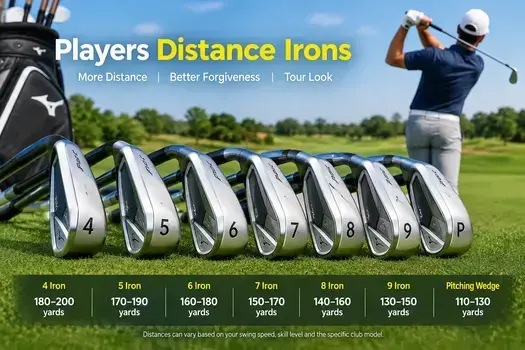
You strike your 7-iron 150 yards while your playing partner carries it 170. That 20-yard gap costs you greens in regulation every round and inflates your scorecard. Players distance irons close that frustrating distance gap while preserving the precise workability, clean turf interaction, and soft feel you expect from a better-player club.
What Are Players Distance Irons?
Players distance irons occupy a unique space between traditional blade irons and full game-improvement models. They feature a compact head shape with a thinner top line that appeals to skilled golfers who care about aesthetics at address.
Inside that clean profile, engineers pack thin-face technology and strategic tungsten weighting to boost ball speed. The result gives you extra carry distance without the bulky look of a super game-improvement iron staring back at you on the tee box.
Think of players distance irons as the sweet spot for golfers who want more yards but refuse to sacrifice shot-shaping control and feedback through their hands.
Players Distance Irons vs Game Improvement Irons
Game improvement irons prioritize maximum forgiveness with wide soles, thick top lines, and oversized heads that inspire confidence for newer golfers. Players distance irons take a completely different approach by keeping the head compact while still adding speed through advanced face technology.
| Feature | Players Distance Irons | Game Improvement Irons |
| Head Size | Compact to mid-size | Large and oversized |
| Top Line | Thin to moderate | Thick |
| Sole Width | Narrow to moderate | Wide |
| Offset | Minimal to moderate | Significant |
| Forgiveness | Moderate | High |
| Workability | High | Low to moderate |
| Target Golfer | Low to mid handicap | Mid to high handicap |
| Feel | Soft and responsive | Dampened |
| Distance Gain | 5–12 yards over blades | 10–20 yards over blades |
The key difference comes down to what you value most on approach shots. If you shape shots on command and want feedback, go compact. If you need the ball to fly straight no matter where you strike the face, go wide.
Who Should Play Players Distance Irons?
Golfers shooting between 72 and 85 benefit most from players distance irons. You already strike the ball consistently and want to squeeze out extra carry without changing your swing mechanics.
- Low handicappers (0–9): You want distance without moving to a clunky game-improvement head.
- Mid handicappers (10–18): You need a little help on thin strikes but still shape shots intentionally.
- High handicappers (19+): A game-improvement set will serve you better right now.
Players distance irons reward good contact and punish mishits more than their forgiving cousins. Be honest about your ball-striking consistency before you commit to this category.
Key Technology Behind Players Distance Irons
Modern players distance irons use multi-material construction to push performance boundaries that were impossible a decade ago. A thin, high-strength steel face flexes at impact to increase the coefficient of restitution (COR) within USGA legal limits (USGA Equipment Rules, usga.org).
Manufacturers place tungsten weights low and deep in the clubhead to optimize the center of gravity. This placement launches the ball higher with less spin, producing a strong, penetrating ball flight that holds greens on long approach shots.
- Thin-face inserts maximize ball speed across a wider area of the face.
- Tungsten toe weighting increases MOI for stability on toe strikes.
- Foam or urethane fillers absorb harsh vibrations while maintaining a solid feel.
- Precision-milled grooves generate consistent spin in wet and dry conditions.
Top Players Distance Irons Compared (2025)
| Model | Head Construction | 7-Iron Loft | Forgiveness (1–10) | Feel (1–10) | Best For |
| Titleist T350 | Hollow body, forged face | 29° | 7 | 8 | Low-mid handicap |
| TaylorMade P790 | SpeedFoam Air, forged | 30° | 8 | 7 | Mid handicap |
| Callaway Apex Pro | Forged 1025 carbon steel | 30° | 6 | 9 | Low handicap |
| Mizuno Pro 225 | Grain flow forged, hollow | 30° | 7 | 9 | Better players |
| Ping i530 | Hollow body, maraging steel | 29° | 8 | 7 | Mid handicap |
| Cobra King Tec | Forged face, hollow body | 29° | 7 | 8 | Mid handicap |
| Srixon ZX5 Mk II | MainFrame face, forged | 30° | 7 | 8 | Low-mid handicap |
Every model in this table delivers measurable distance gains over a traditional blade. Your final choice should come down to feel preference, look at address, and how the head interacts with your specific turf conditions.
Forgiveness and Feel: Finding the Right Balance
Forgiveness and feel often pull in opposite directions during iron design. A thicker face and larger cavity increase the moment of inertia (MOI) for stability on off-center hits, but they can mute the feedback skilled golfers rely on.
The best players distance irons thread this needle by using urethane inserts or foam fillers that dampen harsh vibrations while preserving the crisp sensation you crave at impact. You get the distance help on thin shots without losing the ability to feel exactly where the ball struck the face.
Test at least three models side by side on a launch monitor. Pay attention to how the club feels on pure strikes versus toe and heel mishits. That contrast tells you everything about the forgiveness-to-feel ratio.
Shaft Selection for Players Distance Irons
Your shaft choice matters just as much as the clubhead when building a set of players distance irons. A shaft that is too stiff will rob you of launch and distance, while one that is too soft will spray shots left and right with no consistency.
- Steel shafts (95–115g): Best for golfers with swing speeds above 85 mph who want control and a penetrating ball flight.
- Graphite shafts (75–90g): Ideal for moderate swing speeds (70–85 mph) where launch assistance matters most.
- Steel-graphite hybrids (85–100g): A growing category that blends the stability of steel with the vibration dampening of graphite.
Most players distance irons pair well with mid-weight steel shafts in the 95–115 gram range. Get the shaft weight and flex right, and you will see tighter dispersion numbers immediately.
Launch Angle and Spin Rate Breakdown
TrackMan data shows that optimal 7-iron launch for amateur golfers falls between 16° and 20° with spin rates of 5,500–7,000 RPM (TrackMan Launch Conditions, trackman.com). Players distance irons typically launch 1–3° higher than traditional blades thanks to their lower center of gravity and stronger lofts.
| Club | Ideal Launch Angle | Ideal Spin Rate (RPM) | Average Carry (yds) |
| 4-Iron | 13°–16° | 4,000–5,000 | 190–210 |
| 5-Iron | 14°–17° | 4,500–5,500 | 175–195 |
| 6-Iron | 15°–18° | 5,000–6,000 | 160–180 |
| 7-Iron | 16°–20° | 5,500–7,000 | 150–170 |
| 8-Iron | 18°–22° | 6,500–8,000 | 135–155 |
| 9-Iron | 20°–25° | 7,500–9,000 | 120–140 |
| PW | 24°–28° | 8,500–10,000 | 105–125 |
If your spin rates fall below these ranges, your shots will balloon or fall out of the sky short of the green. If they sit above, you lose carry distance to excessive backspin. A fitting session will dial these numbers in precisely.
How to Get Fitted for Players Distance Irons
A proper fitting session on a launch monitor removes the guesswork from your purchase entirely. A certified fitter will test your swing speed, attack angle, and dynamic loft to match you with the right head and shaft combination for your swing.
MyGolfSpy’s independent testing confirms that a professional fitting adds an average of 5–8 yards of carry and tightens dispersion by 15–20% (MyGolfSpy Iron Testing, mygolfspy.com). Those numbers translate directly to more greens hit and fewer recovery shots from the rough.
Bring your current irons to the session so the fitter can identify exact gaps in your set. Ask to test each candidate model with your preferred shaft to get the most accurate comparison data.
Players Distance Irons for Mid Handicappers
Mid handicappers (10–18) represent the largest group shopping for players distance irons right now. You hit enough solid shots to appreciate a compact profile, but you still need help on thin and toe strikes that creep into your round every few holes.
Look for models with moderate offset and a slightly wider sole than a pure blade. These design elements help square the face at impact and prevent digging on fat shots when your tempo gets quick under pressure.
The TaylorMade P790 and Ping i530 consistently rank as top choices for this handicap range because they offer the most generous forgiveness while maintaining a clean, confidence-inspiring look at address.
Common Mistakes When Buying Players Distance Irons
The biggest mistake golfers make is buying a set based on a professional’s bag setup. Tour players swing 20–30 mph faster than the average amateur, and their equipment reflects that speed with stiffer shafts and weaker lofts.
Another error is ignoring gapping between clubs. Strong lofts on players distance irons can create large yardage gaps between your pitching wedge and gap wedge that leave you stuck with awkward half-swing distances.
- Do not skip the fitting. Off-the-rack specs rarely match your actual swing characteristics.
- Do not chase distance alone. A 7-iron that flies 185 yards is useless if it cannot hold a green.
- Do not ignore the short end of the set. Make sure your PW and GW gaps make sense for your course.
Plan your full set composition before you commit to a purchase. Your scoring will thank you.
Players Distance Irons Price and Value Guide
| Price Tier | Range | What You Get | Example Models |
| Budget | $600–$900 | Solid performance, fewer custom options | Cobra King Tec, Srixon ZX5 |
| Mid-Range | $900–$1,300 | Premium materials, full fitting options | Titleist T350, Ping i530 |
| Premium | $1,300–$1,800 | Tour-level construction, exotic shafts | Callaway Apex Pro, Mizuno Pro 225 |
| Custom/Tour | $1,800+ | Fully bespoke build, limited runs | TaylorMade P790 Custom |
Players distance irons in the mid-range tier deliver the best value for most golfers. You get forged faces, tungsten weighting, and full shaft menus without paying tour-department premiums that offer diminishing returns for amateur swings.
Frequently Asked Questions
What handicap should play players distance irons?
Golfers with a handicap between 5 and 18 get the most benefit. You need consistent ball striking to take advantage of the compact head shape and workability these irons provide on approach shots.
Are players distance irons good for beginners?
No. Beginners should start with game-improvement or super game-improvement irons that offer maximum forgiveness on mishits. Players distance irons demand a repeatable swing to perform well and will punish poor contact.
How much distance do players distance irons add?
Most golfers gain 5–12 yards of carry compared to traditional blade irons. The exact gain depends on your swing speed, attack angle, and the specific model and loft configuration you choose.
What distinguishes players’ distance irons from players’ irons?
Players irons (blades) prioritize feel and workability with minimal distance assistance. Players distance irons add thin-face technology and strategic weighting to boost ball speed while keeping a compact, tour-inspired profile.
Do players distance irons have strong lofts?
Yes. Most players distance irons feature 7-iron lofts between 29° and 31°, compared to 33°–35° on traditional blades. Stronger lofts contribute significantly to the distance gains you see on a launch monitor.
Can high handicappers use players distance irons?
High handicappers (20+) can physically use them, but the reduced forgiveness will likely cost you strokes on mishits. A game-improvement iron set will help you score better while you develop a more consistent swing.
Take Control of Your Iron Game Today
Your iron game dictates your scoring more than any other part of your bag. Every approach shot that lands five yards closer to the pin translates to shorter putts and lower numbers on your card by the end of the round.
Book a fitting session this month, test at least three models from the comparison table above, and walk away with a set of players distance irons that matches your actual swing—not your ego or your favorite tour pro’s setup. The right irons will not fix a broken swing, but they will reward the good strikes you already make with the distance and control your game deserves.