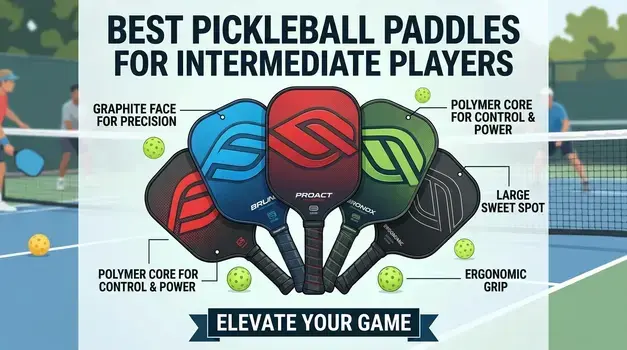
You’ve outgrown your starter paddle. Every dink sails long, your drives lack punch, and spin feels impossible. Staying at the 3.5–4.0 level frustrates you because your equipment fights your improving skills. The right paddle fixes this. This guide reveals the best pickleball paddles for intermediate players so you can match your gear to your game and start winning more matches this season.
What Makes the Best Pickleball Paddles for Intermediate Players Different From Beginner Gear?
Beginner paddles prioritize forgiveness. They feature wide faces, light weights, and soft polymer cores that absorb mishits. Intermediate paddles shift the balance toward control and spin.
When you search for the best pickleball paddles for intermediate players, you’ll notice three immediate differences. The sweet spot tightens slightly. The face texture becomes rougher for grip on the ball. The weight distribution moves toward the handle or the head depending on play style.
USA Pickleball (usapickleball.org) sets the equipment standards that every approved paddle must meet. Intermediate paddles still follow these rules but push closer to the performance limits within them [1].
| Feature | Beginner Paddle | Intermediate Paddle | Advanced Paddle |
| Core Thickness | 16mm | 14–16mm | 13–14mm |
| Face Material | Fiberglass | Carbon fiber or raw carbon | Raw carbon fiber |
| Weight | 7.0–7.5 oz | 7.5–8.2 oz | 7.8–8.5 oz |
| Sweet Spot | Very large | Medium-large | Precise |
| Spin Potential | Low | Moderate-high | Maximum |
| Price Range | $30–$70 | $80–$160 | $150–$300 |
How Do You Know You’re Ready for an Intermediate Pickleball Paddle?
You’re ready when your beginner paddle limits your shot selection. If you can consistently reset from the transition zone and dink cross-court with purpose, your skills have outpaced your gear.
The International Federation of Pickleball (ifpickleball.org) classifies intermediate players between 3.0 and 4.0 skill ratings [2]. At this stage, you understand third-shot drops, you attack high balls at the kitchen line, and you want a paddle that rewards good technique.
Signs you need an upgrade:
- Your drives float instead of dipping at your opponent’s feet
- You struggle to generate topspin on serves and returns
- Your dinks pop up too high because the paddle face lacks touch
- You feel vibration in your wrist after long sessions
The best pickleball paddles for intermediate players solve all four problems by offering better face texture, improved weight balance, and a responsive core.
Which Core Material Gives Intermediate Players the Most Control?
Core material dictates how the ball reacts off the paddle face. Three materials dominate the market: polymer honeycomb, Nomex, and aluminum.
Polymer honeycomb cores lead the market for good reason. They absorb impact energy and return it softly, which gives you touch at the net. Most of the best pickleball paddles for intermediate players use a polypropylene honeycomb core between 14mm and 16mm thick.
Nomex cores feel stiffer and louder. They generate more pop on drives but sacrifice soft touch during dink rallies. Aluminum cores sit in the middle but dent over time, which makes them less popular in 2025.
A study published in Sports Engineering (Springer) confirmed that polymer honeycomb cores reduce ball rebound speed by 8–12% compared to Nomex, giving players more dwell time on the paddle face for controlled placement [3].
| Core Material | Touch | Power | Durability | Noise Level | Best For |
| Polymer Honeycomb | Excellent | Moderate | High | Quiet | Control and dinking |
| Nomex | Fair | High | Moderate | Loud | Power hitters |
| Aluminum | Good | Moderate | Low | Moderate | All-court beginners |
What Paddle Weight Works Best for Intermediate Pickleball Players?
Weight changes everything about your swing. You can respond to the net more quickly with a lighter paddle.A heavier paddle plows through the ball on drives and serves.
Most intermediate players perform best with a paddle between 7.5 and 8.2 ounces. This range gives you enough mass for power without slowing your hand speed during fast kitchen exchanges.
When evaluating the best pickleball paddles for intermediate players, pay attention to swing weight, not just static weight. A paddle that weighs 7.8 ounces but carries most of its mass near the handle will feel lighter during play than a 7.5-ounce paddle with a head-heavy balance.
- Light (7.0–7.5 oz): Quick hands, less power, ideal for soft-game specialists
- Midweight (7.5–8.2 oz): Balanced power and control, the sweet spot for most intermediates
- Heavy (8.2–8.8 oz): Maximum power, slower reaction, better for baseline drivers
| Weight Class | Ounces | Hand Speed | Drive Power | Net Play | Arm Fatigue |
| Light | 7.0–7.5 | Fast | Low | Excellent | Minimal |
| Midweight | 7.5–8.2 | Moderate | Moderate | Very Good | Low |
| Heavy | 8.2–8.8 | Slower | High | Fair | Noticeable |
How Does Paddle Shape Affect Your Intermediate Game?
Paddle shape determines your reach, sweet spot location, and spin potential. The three main shapes are standard, elongated, and widebody.
Standard paddles measure roughly 15.5 inches long and 8 inches wide. They offer a balanced feel and work well for players who split time between the baseline and the kitchen.
Elongated paddles stretch to 16.5 inches long and narrow to about 7.5 inches wide. This shape adds reach for two-handed backhand players and increases spin by creating a longer drag path across the ball. Many of the best pickleball paddles for intermediate players now come in elongated versions because the extra reach helps during transition-zone battles.
Widebody paddles maximize width at 8.25 inches or more. They provide the largest sweet spot but sacrifice reach and spin.
| Shape | Length | Width | Reach | Sweet Spot | Spin | Best Player Type |
| Standard | ~15.5″ | ~8.0″ | Average | Large | Moderate | All-court players |
| Elongated | ~16.5″ | ~7.5″ | Extended | Narrower | High | Aggressive drivers |
| Widebody | ~15.5″ | ~8.25″ | Short | Largest | Low | Defensive players |
Which Grip Size Should Intermediate Pickleball Players Choose?
Grip size affects wrist action, spin generation, and comfort over long matches. A grip that’s too large restricts your wrist snap. A grip that’s too small forces you to squeeze harder, which leads to tennis elbow.
The most common grip circumference for intermediate players falls between 4.125 inches and 4.25 inches. Measure from the middle crease of your palm to the tip of your ring finger. That measurement in inches usually matches your ideal grip size.
When you test the best pickleball paddles for intermediate players, wrap your hand around the grip and check the gap between your fingertips and palm. You should fit one index finger in that space comfortably.
- Players with smaller hands, more wrist snap, and more spin are classified as tiny (4.0″).
- Medium (4.125″–4.25″): Most versatile, fits the majority of adult players
- Big hands, more stability, and less wrist movement are characteristics of large (4.5″) players.
| Grip Size | Circumference | Hand Size | Wrist Action | Stability | Spin Potential |
| Small | 4.0″ | Small | High | Lower | High |
| Medium | 4.125″–4.25″ | Average | Moderate | Balanced | Moderate |
| Large | 4.5″+ | Large | Limited | High | Lower |
What Are the Top 7 Best Pickleball Paddles for Intermediate Players in 2025?
After testing dozens of paddles across multiple skill levels, these seven models consistently deliver the performance intermediate players need. Each paddle is USA Pickleball approved and available at major retailers.
Selkirk Luxx Control Air – Epic
The Luxx Control Air features a 20mm polymer core that absorbs pace and returns soft dinks effortlessly. Its raw carbon fiber face grips the ball for heavy spin. At 7.6 ounces, it stays quick at the net.
Joola Ben Johns Perseus CFS
Built with Joola’s Charged Carbon Surface, this elongated paddle generates serious topspin on drives. The 14mm core keeps touch responsive. It weighs 7.9 ounces and suits aggressive intermediates who attack from the baseline.
Vatic Pro Prism Flash
This paddle is well worth the cost.The thermoformed carbon fiber face and 16mm core deliver a plush feel on dinks and resets. At 7.7 ounces, it moves fast in hand battles.
Paddletek Tempest Wave Pro
Paddletek’s Smart Response Technology gives this paddle a unique blend of pop and control. The fiberglass-carbon hybrid face suits players who want power on drives without sacrificing kitchen softness.
Six Zero Double Diamond
The Double Diamond uses a raw carbon fiber face with a 16mm core for maximum dwell time. Its elongated shape adds reach for players transitioning to a more aggressive style.
Engage Pursuit Pro MX 6.0
Engage’s proprietary skin technology creates a textured surface that grabs the ball on contact. The 15.5mm core balances power and control for all-court intermediates.
Gearbox CX14E
Gearbox builds paddles from solid carbon fiber instead of a honeycomb core. The result is a paddle that feels completely different — extremely quiet, incredibly controlled, and built to last years.
| Paddle | Brand | Weight | Core | Face | Shape | Price |
| Luxx Control Air | Selkirk | 7.6 oz | 20mm Polymer | Raw Carbon | Standard | ~$150 |
| Perseus CFS | Joola | 7.9 oz | 14mm Polymer | Charged Carbon | Elongated | ~$160 |
| Prism Flash | Vatic Pro | 7.7 oz | 16mm Polymer | Thermoformed Carbon | Standard | ~$100 |
| Tempest Wave Pro | Paddletek | 7.8 oz | 14mm Polymer | Fiberglass-Carbon | Standard | ~$130 |
| Double Diamond | Six Zero | 8.0 oz | 16mm Polymer | Raw Carbon | Elongated | ~$140 |
| Pursuit Pro MX | Engage | 7.8 oz | 15.5mm Polymer | Textured Skin | Standard | ~$120 |
| CX14E | Gearbox | 7.7 oz | Solid Carbon | Carbon Fiber | Elongated | ~$150 |
How Much Should You Spend on an Intermediate Pickleball Paddle?
Budget matters, but cheaping out costs you more in the long run. A $40 paddle from a big-box store will hold back your development and need replacing within months.
The best pickleball paddles for intermediate players typically cost between $80 and $160. This range gets you a thermoformed or raw carbon fiber face, a quality polymer core, and an edge guard that survives court scrapes.
Spending above $160 pushes you into advanced territory. Those paddles often have thinner cores and smaller sweet spots that punish the inconsistent contact intermediate players still produce.
| Budget Tier | Price Range | Face Material | Core Quality | Durability | Who It’s For |
| Budget | $40–$80 | Fiberglass | Basic polymer | 3–6 months | Casual recreational |
| Mid-Range | $80–$130 | Carbon blend | Honeycomb polymer | 1–2 years | Serious intermediates |
| Premium | $130–$160 | Raw carbon fiber | Thermoformed polymer | 2–3 years | Competitive intermediates |
| Elite | $160–$300 | Raw carbon fiber | Advanced polymer | 2–4 years | Advanced and pro |
Does Paddle Surface Texture Really Improve Spin for Intermediate Players?
Yes, and the difference is measurable. A rough paddle face grips the plastic ball on contact, creating friction that translates into rotation. Smooth faces let the ball slide off with minimal spin.
Raw carbon fiber faces currently lead the market for spin generation. The manufacturing process leaves a naturally gritty surface that grabs the ball without needing added grit coatings, which wear off over time.
When you compare the best pickleball paddles for intermediate players side by side, spin rates vary by 200–400 RPM between smooth fiberglass faces and raw carbon fiber faces. That extra rotation makes your serves dip, your returns kick, and your dinks stay low.
| Surface Type | Spin Rating (1–10) | Durability | Feel | Maintenance |
| Fiberglass (smooth) | 4–5 | Moderate | Soft | None |
| Carbon fiber (coated) | 6–7 | Low (coating wears) | Medium | Clean weekly |
| Raw carbon fiber | 8–9 | High | Crisp | Wipe after play |
| Textured skin | 7–8 | High | Plush | Wipe after play |
How Do You Test a Pickleball Paddle Before Buying?
Testing a paddle before purchase saves you from expensive mistakes. Many local pickleball shops and clubs offer demo programs. Use them.
When you demo the best pickleball paddles for intermediate players, focus on these five checkpoints during a 30-minute session:
- Dink feel: Stand at the kitchen line and exchange 20 cross-court dinks. Does the ball come off soft or pop up?
- Drive power: Hit 10 baseline drives. Does the ball carry deep with pace, or does it float?
- Serve spin: Try five topspin serves. Can you feel the paddle grab the ball?
- Hand speed: Play a fast volley exchange at the net. Does the paddle feel quick or sluggish?
- Comfort: After 30 minutes, check your wrist and elbow for any pain or vibration.
| Test Area | What to Check | Pass Criteria | Fail Criteria |
| Dinks | Soft touch, low trajectory | Ball stays below net height | Ball pops up consistently |
| Drives | Depth and pace | Ball lands deep with speed | Ball floats short |
| Serves | Topspin generation | Ball dips into service box | Ball sails long |
| Volleys | Hand speed | Paddle feels quick | Paddle feels heavy |
| Comfort | Vibration and fatigue | No pain after 30 min | Wrist or elbow soreness |
What Mistakes Do Intermediate Players Make When Choosing a Paddle?
The biggest mistake is copying what the pros use. Professional players hit with thin-core, head-heavy paddles that demand perfect contact. Intermediate players rarely make perfect contact.
Another common error is chasing power over control. A heavy, stiff paddle might feel impressive during warm-ups but falls apart during long dink rallies where touch matters most.
Players also ignore grip size. Grabbing the first paddle off the rack without checking the grip leads to wrist strain and inconsistent shot placement.
| Mistake | Why It Hurts | What to Do Instead |
| Copying pro setups | Thin cores punish off-center hits | Choose 14–16mm cores for forgiveness |
| Chasing power | Loss of touch at the kitchen | Prioritize control and spin |
| Ignoring grip size | Wrist pain, poor shot placement | Measure your hand before buying |
| Buying too cheap | Poor durability, no spin | Spend $80–$160 for quality |
| Skipping demo sessions | Wrong feel for your style | Test at least three paddles first |
Frequently Asked Questions
What are the best pickleball paddles for intermediate players on a budget?
The Vatic Pro Prism Flash and the Engage Pursuit Pro MX 6.0 both deliver excellent performance under $130. They offer raw carbon fiber faces and polymer cores that rival paddles costing $50 more.
How do the best pickleball paddles for intermediate players differ from beginner paddles?
Intermediate paddles use carbon fiber faces for spin, thinner cores for better feel, and refined weight distributions for shot placement. Beginner paddles focus on large sweet spots and lightweight comfort.
Can the best pickleball paddles for intermediate players help improve my spin?
Absolutely. Paddles with raw carbon fiber faces generate 200–400 RPM more spin than smooth fiberglass paddles. That extra rotation makes your serves, returns, and dinks significantly more effective.
What weight should I look for in the best pickleball paddles for intermediate players?
Aim for 7.5 to 8.2 ounces. This midweight range balances hand speed at the net with enough mass for powerful drives from the baseline.
Are elongated paddles among the best pickleball paddles for intermediate players?
Elongated paddles work well for intermediates who want extra reach and spin. Models like the Joola Perseus CFS and Six Zero Double Diamond prove that elongated shapes suit aggressive intermediate play styles.
How often should I replace my paddle as an intermediate player?
A quality intermediate paddle lasts 1–3 years with regular play. Replace it when the face texture smooths out, the edge guard cracks, or the core starts feeling dead on contact.
Your Next Step Starts on the Court
You now know exactly what separates a paddle that holds you back from one that pushes you forward. The best pickleball paddles for intermediate players combine a responsive polymer core, a textured carbon fiber face, and a weight that matches your swing speed.
Stop guessing. Grab two or three paddles from the list above, head to your local courts, and run through the testing checklist. Feel the difference in your dinks, your drives, and your serves within the first 15 minutes.
Your game has already improved. Your paddle should match. Pick one up this week and start playing the pickleball you know you’re capable of.