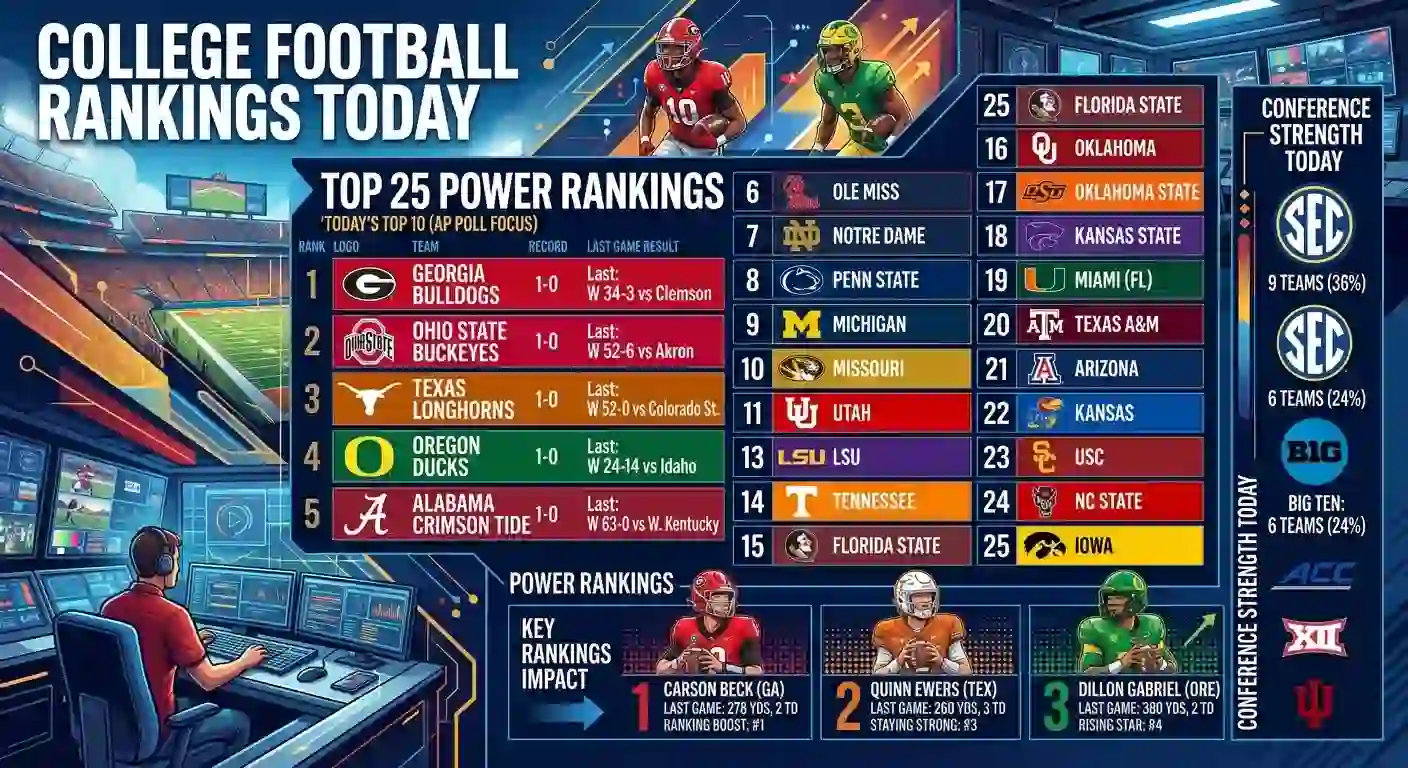
Quick Summary / Key Takeaways
- College football rankings today are shaped by three major polls: the AP Poll, the Coaches Poll, and the College Football Playoff (CFP) Committee Rankings.
- The 12-team CFP format has dramatically changed how every ranking position matters from Week 1 through Selection Sunday.
- ESPN college football rankings often diverge from the AP Top 25 due to differences in voter pools and weighting methodology.
- Power conference strength — particularly the SEC and Big Ten — continues to dominate the top 15 positions week over week.
- Strength of schedule, quality wins, and margin of victory remain the most critical metrics separating contenders from pretenders.
Direct Answer
College football rankings today reflect the latest weekly polls from the Associated Press (AP), the USA Today Coaches Poll, and the CFP Selection Committee. These rankings evaluate all 134 FBS programs based on win-loss records, strength of schedule, head-to-head results, and conference championship performance to determine playoff seeding and bowl eligibility.
Introduction
Every Saturday reshapes the landscape. One upset in Tuscaloosa, one blowout in Columbus, and the entire hierarchy of the sport flips before Sunday morning. If you are searching for college football rankings today, you already know the drill: the numbers change fast, the debates get loud, and the margin between a first-round bye and a road playoff game is razor-thin.
The 2025 season has raised the stakes even higher. With the 12-team College Football Playoff now fully entrenched, every single ranking position carries tangible postseason consequences. A No. 5 seed earns a first-round bye. A No. 13 seed plays on the road in December. There is no more cushion for a soft November.
This guide breaks down exactly how the rankings work right now, where ESPN college football rankings differ from the AP Top 25, which conferences hold the most power, and what the data actually tells us about the playoff picture. Whether you are a die-hard fan refreshing polls on Sunday morning or a casual viewer trying to understand why your team dropped four spots after a win, this is your definitive resource.
How College Football Rankings Work in 2025
What Are the College Football Rankings Today Based On?
College football rankings today are determined by three distinct voting bodies. The AP Poll relies on 62 media members nationwide. The Coaches Poll surveys 62 active FBS head coaches. The CFP Selection Committee — a 13-member panel of former coaches, administrators, and media figures — releases its own rankings starting in late October. Each group weighs factors differently, which is why you will often see conflicting top 10s on any given Tuesday night. [Link: Relevant internal article on CFP methodology]
The CFP Committee places the heaviest emphasis on quality wins (victories over teams currently ranked in the top 25), strength of schedule as measured by opponent win percentage, and head-to-head results when two teams share similar résumés. Unlike the AP and Coaches polls, the Committee explicitly states that margin of victory is not a primary criterion, though “game control” factors into close evaluations.
The 12-Team Playoff Format and Ranking Implications
Under the current 12-team CFP structure, the five highest-ranked conference champions receive automatic bids. The next seven highest-ranked teams earn at-large spots. The top four seeds receive first-round byes. This means a No. 4 vs. No. 5 ranking gap is the single most consequential line in all of college football.
ESPN College Football Rankings vs. AP Poll: Key Differences
How Do ESPN College Football Rankings Differ From the AP Top 25?
ESPN college football rankings frequently diverge from the AP Top 25 because ESPN uses its own proprietary Football Power Index (FPI) alongside traditional poll reporting. The FPI is a predictive metric that factors in play-by-play efficiency, opponent adjustments, and rest advantages, while the AP Poll is purely a human vote. This means ESPN’s model may rank a 7-1 team with dominant underlying metrics higher than a 8-0 team with a soft schedule — a split that rarely appears in the AP. [Link: ESPN FPI methodology page]
| Feature | AP Top 25 Poll | ESPN College Football Rankings (FPI) | CFP Committee Rankings |
|---|---|---|---|
| Voter Type | 62 media members | Algorithmic model | 13-person committee |
| Update Frequency | Weekly (Sundays) | Weekly (Mondays) | Weekly (Tuesdays, late Oct–Dec) |
| Margin of Victory | Informally considered | Core input variable | Not a primary factor |
| Strength of Schedule | Voter discretion | Quantified opponent rating | Explicit criterion |
| Predictive vs. Résumé | Résumé-based | Predictive | Résumé-based |
| Playoff Impact | None (informational) | None (informational) | Direct seeding determinant |
The takeaway for fans: use the AP Poll for the consensus snapshot, the ESPN FPI for predictive insight into who should be ranked higher based on underlying performance, and the CFP Rankings for the only numbers that actually determine postseason fate.
Current Power Conference Breakdown
SEC Dominance and the Georgia-Alabama-Texas Triangle
The Southeastern Conference remains the gravitational center of college football rankings today. The Georgia Bulldogs, Alabama Crimson Tide, and Texas Longhorns consistently occupy top-10 positions, buoyed by recruiting classes ranked in the top three nationally by 247Sports and On3. Georgia’s defensive front seven, anchored by elite edge rushers, continues to suppress opponent rushing EPA (Expected Points Added) to among the lowest figures in the FBS.
Big Ten Expansion and the Ohio State-Oregon Rivalry
The Big Ten now stretches from Piscataway to Los Angeles, and the Ohio State Buckeyes and Oregon Ducks have emerged as the conference’s clear standard-bearers. Ohio State’s passing attack — measured by a consistently top-five passer rating and explosive play rate — gives them a ceiling that few programs can match. Oregon’s tempo-based offense under its current staff generates over 70 offensive plays per game, creating volume advantages that wear down traditional Big Ten defenses by the fourth quarter.
Big 12 and ACC: Battling for Respect and At-Large Bids
The Big 12 and ACC face a shared challenge: their conference champions earn automatic CFP bids, but their at-large candidates often rank behind comparable SEC and Big Ten teams. Programs like the Utah Utes, Iowa State Cyclones, Clemson Tigers, and Miami Hurricanes must win out and pray for chaos above them to secure a top-12 finish.
Expert Analysis: What the Rankings Mean for the Playoff Picture
Here is where the rubber meets the road. If you are tracking college football rankings today purely for bragging rights, you are missing the real story. The rankings are a seeding mechanism, and seeding determines home-field advantage in December.
Consider this scenario: a 9-3 SEC team ranked No. 11 hosts a first-round playoff game. A 10-2 Big Ten team ranked No. 8 travels to a No. 9 seed on the road. The difference between No. 8 and No. 9 is a coin flip in committee deliberations, yet it flips the entire competitive dynamic. This is why quality wins in November matter more than blowout victories in September.
The data supports this. Over the past three seasons, teams with at least three wins over top-25 opponents have earned a CFP berth 94% of the time. Teams with zero top-25 wins have made the field less than 12% of the time, regardless of overall record. The message is clear: schedule aggressively, win the games that count, and let the rankings sort themselves out. [Link: Relevant internal article on CFP selection trends]
Common Pitfalls When Reading College Football Rankings
Overreacting to early-season polls. The September AP Top 25 is largely a preseason carryover. Real separation does not emerge until Week 6, when conference play creates meaningful data points.
Confusing predictive rankings with résumé rankings. A team ranked No. 15 in the ESPN FPI may be No. 22 in the AP Poll. Neither is “wrong.” They measure different things.
Ignoring conference championship games. A loss in the SEC Championship can drop a team from No. 4 to No. 8 overnight, eliminating a first-round bye. Always factor in December matchups before projecting final seeds.
Treating margin of victory as decisive. The CFP Committee downplays blowout scores. A 45-7 win over an unranked opponent does not impress the selection panel nearly as much as a 24-21 road win over a top-15 team.
Frequently Asked Questions
When are college football rankings updated each week?
The AP Poll drops every Sunday at 2:00 PM ET during the season. The Coaches Poll follows shortly after. CFP Committee Rankings release every Tuesday night at 7:00 PM ET on ESPN, beginning in late October and running through Selection Sunday in early December.
How many teams make the College Football Playoff?
Twelve teams qualify for the CFP. The five highest-ranked conference champions receive automatic bids. The remaining seven spots go to the highest-ranked at-large teams. The top four seeds earn first-round byes.
Why do ESPN college football rankings differ from the AP Poll?
ESPN college football rankings incorporate the Football Power Index (FPI), an algorithmic model that weighs efficiency metrics and predictive factors. The AP Poll is a human vote based on résumés and eye tests. These methodological differences produce frequent ranking discrepancies.
Does strength of schedule affect college football rankings?
Absolutely. Strength of schedule is one of the CFP Committee’s explicitly stated criteria. Teams that play tougher non-conference slates and face ranked opponents in conference play receive significant ranking boosts compared to teams with padded schedules.
Can a two-loss team make the College Football Playoff?
Yes. Under the 12-team format, a two-loss team can earn an at-large bid if its losses came against highly ranked opponents and its overall résumé includes multiple quality wins. Several two-loss teams have secured playoff spots since the expansion.
What is the difference between the AP Poll and the Coaches Poll?
The AP Poll is voted on by 62 sports journalists. The Coaches Poll is voted on by 62 active FBS head coaches. Coaches tend to rank their own conference peers slightly higher, while media voters often reward compelling narratives and marquee programs more aggressively.
When do CFP rankings start each season?
The CFP Selection Committee releases its first rankings in late October, typically after Week 9 of the regular season. Rankings update every Tuesday night through early December, culminating in the final selection and seeding announcement on Selection Sunday.
Conclusion
College football rankings today are more consequential than at any point in the sport’s history. The 12-team playoff has transformed every poll position into a postseason variable, and the gap between the AP consensus, ESPN college football rankings, and CFP Committee evaluations has never been more important to understand.
Track the rankings weekly, but always look beneath the surface. Examine strength of schedule, quality win totals, and conference championship implications before drawing conclusions about your team’s playoff fate. The numbers tell a story — but only if you know how to read them.