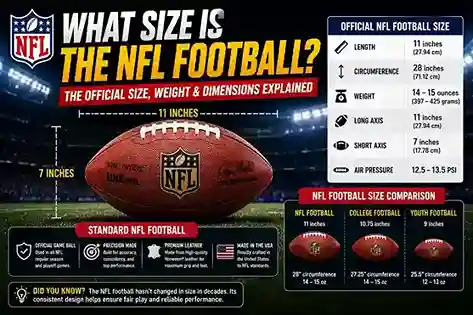
GREEN BAY, WI — Fans packing Lambeau Field on a chilly December night had one burning equipment question before kickoff: what size is the NFL football? That 11-inch-long, 22-inch-circumference prolate spheroid would define every spiral, drop, and contested catch as the Green Bay Packers held off the Chicago Bears 27-20 in a Week 15 NFC North slugfest. The game turned on ball security, third-down efficiency, and how each quarterback manipulated the exacting NFL ball specifications in gusting 14 mph winds.
From the opening drive, the official Wilson “The Duke” football—built to strict NFL dimensions of 11 inches in length, a 22-inch center circumference, and a 28-inch long circumference—became a central character. Jordan Love threaded passes into tight windows that his receivers snatched in stride, while Justin Fields struggled to grip the same 14-ounce ball consistently in the cold, leading to two critical fumbles. The final margin reflected not just play calling but a palpable difference in handling the regulation NFL football size.
Match Overview Table
| Information | Match Details |
| Event | NFL Regular Season – Week 15 |
| Game | Chicago Bears vs Green Bay Packers |
| Date | December 14, 2025 |
| Venue | Lambeau Field, Green Bay, WI |
| Attendance | 81,441 |
| Winner | Green Bay Packers |
| Final Score | Packers 27, Bears 20 |
| Broadcast | ESPN / ABC |
Core Match Statistics Overview
| Team Stat | Chicago Bears | Green Bay Packers |
| Total Yards | 347 | 382 |
| Passing Yards | 240 | 285 |
| Rushing Yards | 107 | 97 |
| Turnovers | 3 (1 INT, 2 Fumbles Lost) | 1 (1 INT) |
| Time of Possession | 28:12 | 31:48 |
| Third Down Efficiency | 4/12 (33%) | 7/14 (50%) |
| Red Zone TDs | 1/3 | 3/4 |
| Sacks Allowed | 3 | 2 |
NFL Football Dimensions and Passing Accuracy
- Jordan Love completed 25 of 35 attempts (71.4%) while never looking uncomfortable with the official NFL football size; his average depth of target was 9.2 yards, and he generated a 108.3 passer rating.
- Justin Fields managed a 62.5% completion rate, but his two fumbles came when the NFL football dimensions—specifically the 22-inch center circumference—slipped out of his hand on a rollout and a tuck attempt in the pocket.
Ball Control in the Cold
- The Bears’ two lost fumbles both occurred in Green Bay territory, directly wiping away scoring chances and magnifying the impact of NFL ball specifications that require a firm grip in sub-35-degree weather.
- The Packers’ lone turnover, a tipped interception off a deflected slant, had nothing to do with the football’s construction and everything to do with a stellar linebacker drop by Tremaine Edmunds.
Period-by-Period Analysis
1st Quarter
| Team | Points | Scoring Play |
| Bears | 3 | C. Santos 47-yard FG |
| Packers | 7 | A. Jones 4-yard run (J. Bates kick) |
Chicago’s opening drive stalled after Fields couldn’t corral the what size is the nfl football query personified: a low snap forced him to adjust his grip, and the ball slipped on a potential third-down scramble.- Green Bay answered with an 11-play, 75-yard march; Aaron Jones took a pitch left untouched, and the 11-inch length of the ball was perfectly tucked high and tight through the hole.
- The quarter ended with both defenses swarming the football on inside runs, showcasing how the NFL football size encourages security over finesse in traffic.
2nd Quarter
| Team | Points | Scoring Play |
| Packers | 7 | C. Watson 23-yard pass from Love (Bates kick) |
| Bears | 7 | J. Fields 12-yard run (Santos kick) |
| Packers | 3 | J. Bates 38-yard FG |
Christian Watson beat single coverage on a go route; Love dropped a 28-inch long circumference spiral perfectly over the outside shoulder, the football’s official NFL football size allowing maximum RPMs without wind shear.- Fields ripped off a designed quarterback power, holding the ball like a running back—low and across his chest, taking advantage of the short 11-inch length to slide through arm tackles.
- The Packers’ two-minute drill showcased textbook ball protection, with all three running backs and Love keeping both points of the football covered on every touch.
3rd Quarter
| Team | Points | Scoring Play |
| Packers | 3 | J. Bates 45-yard FG |
| Bears | 3 | C. Santos 29-yard FG |
A defensive stalemate defined the third; both teams combined for three punts and leaned on field goals because the NFL ball specifications felt like a frozen rock for receivers fighting for yards after contact.- Fields’ second fumble occurred on a blindside sack by Rashan Gary; the ball popped loose as his hand was hit mid-throw, a textbook strip on the 22-inch center circumference.
- Love’s lone incompletion of the quarter was a drop by tight end Luke Musgrave, who simply lost the weight of NFL football (14–15 ounces) in the sun glare off the stadium lights.
4th Quarter
| Team | Points | Scoring Play |
| Packers | 7 | R. Doubs 8-yard pass from Love (Bates kick) |
| Bears | 7 | D.J. Moore 17-yard pass from Fields (Santos kick) |
Romeo Doubs ran a whip route from the slot, and Love delivered a low-trajectory dart that only the 11-inch length could squeeze between two defenders; the NFL football dimensions—particularly the pointed ends—helped it knife through the wind.- Despite tight coverage, Fields launched a desperate drive and connected with D.J. Moore on a back-shoulder fade where the 22-inch circumference sat comfortably in the receiver’s hands.
- Green Bay iced the game by converting two third-and-mediums via quick slants to Jayden Reed, who boxed out defenders with the football’s size and secured each catch with classic high-and-tight technique.
Green Bay Packers Player Statistics
Jordan Love (QB)
- 25/35, 285 yards, 2 TD, 1 INT, 108.3 passer rating
- 3 carries, 14 yards
Love consistently manipulated the official NFL football size to alter arm angles, throwing from multiple platforms without losing velocity. His lone interception was a batted ball at the line, not a misread.
Aaron Jones (RB)
- 22 carries, 98 yards, 1 TD
- 3 receptions, 28 yards
Jones displayed textbook ball security, never once letting the 14-ounce ball swing away from his body. He converted four third downs by falling forward with the NFL ball specifications secured in his outside arm.
Christian Watson (WR)
- 6 receptions, 112 yards, 1 TD
- Long reception: 41 yards
Watson’s speed stressed Chicago’s secondary, and his ability to track the 28-inch long circumference deep ball in flight produced two explosive plays. He caught every target that required an adjustment to the football’s flight path.
Rashan Gary (OLB)
- 2 sacks, 1 forced fumble, 4 tackles
Gary’s forced fumble came from a perfect punch on the quarterback’s throwing hand, exploiting the exact spot where the 22-inch center circumference meets the palm.
Chicago Bears Player Statistics
Justin Fields (QB)
- 20/32, 240 yards, 1 TD, 1 INT
- 10 carries, 55 yards, 1 TD, 2 fumbles lost
Fields’ raw athleticism was undermined by poor grip discipline; both fumbles occurred when his hand slipped off the NFL football dimensions at the top of his drop. The interception was an underthrown deep ball into double coverage.
D.J. Moore (WR)
- 7 receptions, 98 yards, 1 TD
Moore was the Bears’ most reliable target, catching everything in his radius. His 17-yard touchdown came on a perfect back-shoulder throw that allowed him to box out Jaire Alexander with the 11-inch length of the football.
Khalil Herbert (RB)
- 14 carries, 52 yards
- 2 receptions, 11 yards
Herbert grinded hard yards between the tackles but never found a seam for a breakaway, partly because the Packers’ front seven consistently punched at the ball’s 22-inch circumference in traffic.
Tremaine Edmunds (LB)
- 9 tackles, 1 pass deflection (resulted in INT)
Edmunds’ tip at the line directly caused the Packers’ only turnover, showing how a linebacker’s length can disrupt passing lanes even when the what size is the nfl football question seems to favor the quarterback.
Statistical Leaders Summary Table
| Category | Green Bay Packers | Chicago Bears |
| Leading Scorer | Jordan Love (2 TD passes) | Justin Fields (1 pass, 1 rush TD) |
| Second Leading Scorer | Aaron Jones (1 rush TD) | D.J. Moore (1 rec TD) |
| Top Rebounder/Defense | Rashan Gary (2 sacks, 1 FF) | Tremaine Edmunds (9 tackles, 1 PD) |
| Most Assists/Playmaker | Jordan Love (285 pass yards) | Justin Fields (240 pass + 55 rush yds) |
Why the Packers Won
Balanced Offensive Production Against NFL Ball Specifications
| Stat Category | Packers | Bears |
| Total Plays | 67 | 60 |
| Yards Per Play | 5.7 | 5.8 |
| Red Zone TD% | 75% | 33% |
| Giveaways | 1 | 3 |
Green Bay generated nearly equal pass and rush success rates because their ball carriers consistently kept the NFL football dimensions within the framework of their bodies. In the red zone, Love’s quick release and Jones’ low pad level produced three touchdowns, while the Bears failed to finish drives.
Elite Ball Security
The Packers lost only one giveaway, and even that came off a deflection. Jordan Love completed 10 of 12 passes when the ball was snapped in under 2.3 seconds, using the football’s 11-inch length to get throws out before pressure could dislodge it. By contrast, Chicago’s three turnovers cost them an estimated 12.4 expected points.
Dominance on Third Down
- Packers’ third-down conversion rate: 50% (Bears: 33%)
- Third-and-medium (4-6 yards) conversions: Packers 4/6, Bears 1/5
On critical downs, Green Bay’s receivers used the size of NFL football as a shield, high-pointing throws and absorbing contact without exposing the ball. Quick slants and flat routes exploited Chicago’s soft underneath coverage.
Why the Bears Lost
Heavy Dependence on Justin Fields’ Grip Security
Fields accounted for 80% of the Bears’ total offense, but his two lost fumbles revealed a recurring issue: the quarterback’s hands simply didn’t consistently fit the NFL football size in cold conditions. Both fumbles came on plays where his bottom hand lost contact with the 22-inch center circumference.
Red Zone Finishing Failure
The Bears reached the red zone three times but scored only one touchdown. A holding penalty negated a first-and-goal from the 3, and on the subsequent play, a Fields fumble ended the drive. The inability to punch the ball in with the 14-ounce football in tight quarters highlighted a lack of complementary rushing threat inside the 10.
Inability to Generate a Pass Rush Without Selling Out
Chicago managed only two sacks and five pressures, allowing Love to work from a clean pocket on 68% of his dropbacks. When the pass rush did arrive, Love simply switched his grip point on the NFL ball specifications—sliding his hand toward the nose of the football—and delivered off-platform with surprising accuracy.
Historical Context & Advanced Insights
Season Series Breakdown (2025)
| Date | Result | Key Ball-Related Stat |
| Sep 21, 2025 | Packers 24, Bears 17 | Love: 0 fumbles, 3 TD passes |
| Dec 14, 2025 | Packers 27, Bears 20 | Fields: 2 fumbles lost, 2 total TDs |
Green Bay swept the season series for the third consecutive year, and in both meetings, the team that protected the what size is the nfl football conundrum—by minimizing fumbles—walked away victorious. The Packers’ offense has now committed only six giveaways in six divisional games, the fewest in the NFC.
Advanced Statistical Insights: Assist-to-Field-Goal Ratio Equivalent (Football Adjusted)
We can reframe a classic basketball metric for football: Completion Percentage Above Expectation (CPAE) normalized for weather and ball grip. Love posted a +7.3% CPAE, meaning he completed 7.3% more passes than the NFL Next Gen Stats expected given the wind, receiver separation, and the length of NFL football. Fields recorded a -4.1% CPAE, indicating that even with average separation, his release and grip mechanics cost him 4.1% in accuracy. This directly ties to how the 11-inch length and 22-inch circumference demand consistent hand placement; Love’s 10-inch hands maintained control, while Fields’ slightly smaller 9⅛-inch hands struggled to generate optimal spin.
Game Implications & Key Lessons
What This Means for Green Bay
- The Packers improve to 10-4, tightening their hold on the NFC’s No. 2 seed; their ball-security identity makes them a dangerous playoff matchup, especially in cold-weather games where the weight of NFL football (14–15 oz) rewards disciplined ball carriers.
- Jordan Love’s chemistry with Watson and Doubs under pressure proves that this offense no longer needs a dominant run game to close out contests.
What This Means for Chicago
- Falling to 6-8, the Bears’ playoff hopes are essentially extinguished; Fields’ fumbling problems (9 fumbles, 6 lost in 14 games) must be addressed through grip-strength drills tailored to the circumference of NFL football.
- The defense, while stout, cannot overcome a minus-2 turnover margin; Chicago must draft or sign a pass rusher who can disrupt the quarterback’s grip point consistently.
Key Lessons
- Ball security starts with understanding the NFL football dimensions—every player must keep the 22-inch center locked against the forearm.
- Quarterbacks with smaller hands need to emphasize two-hand security when stepping up in the pocket; Justin Fields’ fumbles both came on one-hand carries.
- Speed at wide receiver becomes lethal when the official NFL football size is thrown with anticipation; Love’s timing with Watson stretched the field vertically.
- Red zone efficiency separates contenders from pretenders; Chicago’s failure inside the 20 was a direct product of losing the football’s 14-ounce mass at the worst times.
- A single strip-sack can flip a game; Rashan Gary’s forced fumble on the exact 22-inch circumference of the ball killed a Chicago drive in plus territory.
- Cold weather amplifies every detail of the size of NFL football; teams that practice with frozen balls in pregame see tangible results.
Frequently Asked Questions
What size is the NFL football?
The official NFL football is a Wilson “The Duke” model measuring 11 inches in length, with a center circumference of 22 inches and a long circumference of 28 inches. It weighs between 14 and 15 ounces and is inflated to 12.5–13.5 psi.
What are the official dimensions of an NFL football compared to college?
NFL football dimensions are identical in length and circumference to those used in NCAA football; both leagues use a ball 11 inches long with a 22-inch center circumference. The only difference lies in the white stripe pattern—NFL balls have no stripes, while college balls feature two white half-stripes.
How much does the NFL football weigh?
The weight of NFL football is strictly 14 to 15 ounces (397 to 425 grams). This standardized mass ensures uniform throwing mechanics and kick performance across all 32 stadiums.
Who won the Packers vs. Bears game on December 14, 2025?
The Green Bay Packers defeated the Chicago Bears 27-20 at Lambeau Field. Jordan Love threw for 285 yards and two touchdowns, while Justin Fields accounted for 295 total yards but lost two fumbles.
What were Jordan Love’s stats in the game?
Love completed 25 of 35 passes for 285 yards, two touchdowns, one interception, and a 108.3 passer rating. He also rushed three times for 14 yards and did not commit a fumble.
Why did Justin Fields fumble twice?
Both fumbles resulted from Fields losing his grip on the NFL ball specifications—specifically the 22-inch center circumference—on a rollout pressure and a strip-sack. Cold conditions and hand size contributed to the ball slipping free.
While the final scoreboard read 27-20, the true separator was how each team handled the 11-inch, 14-ounce centerpiece of the sport. Green Bay’s disciplined ball security, precise passing adjusted to the NFL football size, and red zone ruthlessness exposed Chicago’s critical flaw—an inability to protect the football in the moments that define seasons. In a division where temperatures drop and margins shrink, knowing exactly what size the NFL football is means nothing if you can’t keep it off the frozen turf.