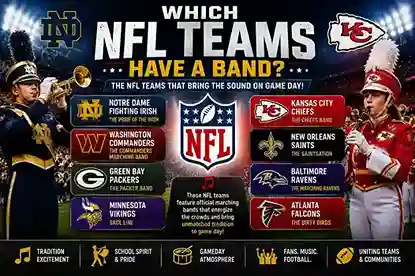
Only two of the 32 NFL franchises maintain a dedicated, team-affiliated marching band in 2026, making live brass-and-percussion pageantry one of the rarest traditions in professional football. The Baltimore Ravens and Washington Commanders are the exclusive keepers of this collegiate-style game-day atmosphere, and their bands carry histories that stretch back decades before the teams themselves existed. Here is the definitive breakdown of which NFL teams have a band, how these ensembles operate, and why the rest of the league has moved on.
1. Title & Intro
Headline: Which NFL Teams Have a Band? The Ravens and Commanders Keep Marching Tradition Alive
The question of which NFL teams have a band usually surprises casual fans, because the answer is just two franchises out of 32. The Baltimore Ravens and Washington Commanders field the only official, team-operated marching bands in the National Football League. On any given home game day, the Marching Ravens and the Commanders Marching Band deliver fight songs, halftime shows, and touchdown celebrations that feel more like Saturday college football than Sunday pro ball.
The Marching Ravens trace their lineage to 1947, when they were founded as the Baltimore Colts’ Marching Band. The Commanders band is even older, established in September 1937 by a local dairy company and quickly adopted by team owner George Preston Marshall. Together, these two ensembles represent the last surviving links to an era when live music was as essential to the NFL experience as the game itself. This article breaks down their history, structure, and the broader landscape of NFL musical entertainment.
2. NFL Band Overview Table
| Information | Details |
| League | National Football League (NFL) |
| Total Teams | 32 |
| Teams with Official Bands | 2 |
| Active Bands | Baltimore’s Marching Ravens, Washington Commanders Marching Band |
| Oldest Band | Washington Commanders Marching Band (1937) |
| Second Oldest | Baltimore’s Marching Ravens (1947) |
| Band Size | Approximately 60–126 members |
| Performance Frequency | All home games, select community events |
3. Core Band Statistics Overview
While NFL bands don’t post box scores, their operational metrics tell a clear story about commitment and scale.
| Metric | Baltimore’s Marching Ravens | Washington Commanders Band |
| Year Founded | 1947 | 1937 |
| Current Membership | ~60 volunteers | ~60–126 members |
| Official Status | Full marching band | Full marching band |
| Home Game Performances | All home games | All home games |
| Fight Song | “The Baltimore Fight Song” | “Hail to the Commanders” |
| Compensation | Part-time employees | Part-time employees |
Band Composition and Size
- The Washington Commanders band grew from 110 original members to 126 pieces by 2010, though current active rosters hover around 60 performers.
- Baltimore’s Marching Ravens maintain a volunteer-based model with approximately 60 dedicated musicians who rehearse weekly during the season.
Game Day Performance Schedule
- Both bands perform pre-game festivities, elaborate halftime shows, and short musical cues during timeouts and breaks in play.
- The Commanders band plays “Hail to the Commanders” after every home touchdown.
Financial and Logistical Support
- Band members are paid as part-time employees of their respective teams, covering instruments, uniforms, travel, and rehearsal space.
- The Washington band received a $20,000 investment in elaborate uniforms in its early years, a significant sum for the era.
4. Historical Period-by-Period Analysis
The Golden Era (1930s–1960s)
During the NFL’s early decades, marching bands were far more common. Many franchises featured dedicated musical ensembles that performed at home games, traveled with the team, and marched in parades. The Green Bay Packers Lumberjack Band, for example, existed for several decades, wearing plaid flannel uniforms and tracing its roots to volunteer groups in the 1920s.
- Key takeaway: Bands were integral to game-day entertainment before stadium sound systems and pre-recorded music became the norm.
The Decline (1970s–1990s)
As entertainment preferences shifted and teams faced rising operational costs, most NFL franchises phased out their dedicated marching bands. The Baltimore Colts’ band survived the team’s 1984 midnight move to Indianapolis by staying together and performing at other events, including the Miss America pageant.
- Key takeaway: The Baltimore band’s resilience during the 11-year gap without an NFL team in Baltimore is a testament to community loyalty.
The Modern Era (2000s–Present)
Today, only the Ravens and Commanders maintain official marching bands. The Commanders band took a two-year hiatus during the COVID-19 pandemic and naming controversy, returning in 2022 as the Washington Commanders Marching Band.
- Key takeaway: Both bands have adapted to modern sensibilities while preserving core traditions like fight songs and pre-game spectacles.
5. Detailed Team Band Profiles
Baltimore’s Marching Ravens
| Attribute | Details |
| Founded | September 7, 1947 |
| Original Name | Baltimore Colts’ Marching Band |
| Current Affiliation | Baltimore Ravens (since 1996) |
| Membership | ~60 volunteers |
| Notable Fact | Supported four separate football franchises |
The Marching Ravens are the longest continuously operating band in professional football, having supported the original Baltimore Colts (1947–1950), the revived Colts (1953–1984), the CFL’s Baltimore Stallions (1994–1995), and finally the Ravens since 1996. Their story was chronicled in the ESPN documentary “The Band That Wouldn’t Die,” directed by Baltimore native Barry Levinson. The band’s persistence through relocation and franchise changes makes them one of the most remarkable institutions in sports.
Washington Commanders Marching Band
| Attribute | Details |
| Founded | September 1937 |
| Original Name | Redskins Marching Band |
| Current Name | Washington Commanders Marching Band |
| Membership | ~60–126 |
| Notable Fact | Oldest marching band in the NFL |
Established in an old firehouse in Mount Rainier, Maryland, the band’s nucleus had previously played together under a local dairy company. Team owner George Preston Marshall invested heavily in the band, commissioning elaborate uniforms and a new fight song—”Hail to the Redskins”—composed by Barnee Breeskin with lyrics by Marshall’s wife, actress Corinne Griffith. The band originally had to be persuaded that the new tune was superior to “Onward, Christian Soldiers,” which the musicians already knew and preferred. Today, the band performs “Hail to the Commanders” after every home touchdown.
6. Band Leaders Summary Table
| Category | Baltimore’s Marching Ravens | Washington Commanders Band |
| Founding Year | 1947 | 1937 |
| Original Name | Baltimore Colts’ Marching Band | Redskins Marching Band |
| Current Director | John Ziemann (decades-long tenure) | Jeffrey Sean Dokken |
| Signature Song | “The Baltimore Fight Song” | “Hail to the Commanders” |
| Unique Distinction | Survived two franchise relocations | Oldest NFL band, established by a dairy company |
7. Analytical Breakdowns (“Why They Survived / Why Others Didn’t”)
Why the Ravens and Commanders Kept Their Bands
Deep Community Roots
Both bands are deeply embedded in their local communities. The Commanders band was founded by local milkmen and volunteers—”printers, plumbers, sheet metal workers; mechanics, painters, electrical engineers; students, bookbinders, and, oh, yes, of course, even musicians”. The Marching Ravens stayed together during Baltimore’s 11-year NFL drought, performing at other events and maintaining their identity.
| Factor | Ravens | Commanders |
| Community Origin | Local musicians | Dairy company employees |
| Survival Through Adversity | Yes (1984–1996) | Yes (2020–2022 hiatus) |
| Volunteer Core | Yes | Yes |
Franchise Commitment to Tradition
Both team ownership groups recognized the band’s value as a differentiator. Art Modell brought the Marching Ravens back immediately when the Browns relocated to Baltimore in 1996. The Commanders revived their band in 2022 after a two-year hiatus, signaling a commitment to tradition despite the naming controversy.
Why Most NFL Teams Don’t Have Bands
Cost and Logistics
Maintaining a full marching band requires substantial financial investment for instruments, uniforms, travel, and personnel salaries. Most teams find it more cost-effective to use pre-recorded music and stadium sound systems.
Changing Entertainment Preferences
Modern NFL game-day experiences prioritize high-energy DJs, light shows, and celebrity performances over traditional marching band pageantry.
Contracted Alternatives
Most NFL teams will bring in a marching band from a local college or high school for specific games or halftime shows, avoiding the overhead of a full-time ensemble.
8. Historical Context & Advanced Insights
Historical Band Prevalence
In the mid-20th century, many NFL teams boasted dedicated marching bands. The Green Bay Packers Lumberjack Band was one notable example, existing for several decades and wearing distinctive plaid flannel uniforms. These bands were often closely tied to local universities or military organizations, fostering strong community connections.
| Era | Band Prevalence | Notable Examples |
| 1930s–1960s | Common | Redskins Band, Packers Lumberjack Band |
| 1970s–1990s | Declining | Most teams phased out bands |
| 2000s–Present | Rare | Only Ravens and Commanders |
Advanced Perspective: The “Band That Would not Die” Phenomenon
Baltimore’s Marching Ravens represent a unique case study in organizational resilience. The band operated continuously from 1947 through the present day, supporting four separate football franchises across two leagues. Their survival through the Colts’ 1984 relocation and the 11-year gap without an NFL team in Baltimore demonstrates how deep community ties can sustain an institution long after its original purpose disappears. This continuity is unmatched in professional sports.
9. Game Implications & Key Lessons
What This Means for the Ravens and Commanders
- Both teams enjoy a distinct game-day atmosphere that sets them apart from the other 30 franchises, reinforcing their brand identity and fan engagement.
- The bands serve as powerful community outreach tools, providing performance opportunities for local musicians and strengthening the team’s connection to its city.
- Maintaining a band signals a commitment to tradition in a league increasingly driven by modern entertainment formats.
What This Means for the Rest of the NFL
- The 30 teams without official bands rely on contracted college bands, high school ensembles, or pre-recorded music to fill the entertainment void.
- The absence of dedicated bands reflects broader shifts in sports entertainment toward technology-driven, high-production-value experiences.
- Franchises considering a band must weigh the substantial financial and logistical costs against the relatively niche appeal of marching music.
Key Lessons
- Tradition matters: The two bands that survived are the ones with the deepest community roots and most compelling origin stories.
- Volunteer models work: Both bands rely heavily on volunteer musicians, keeping costs manageable while maintaining quality.
- Adaptability is essential: The Commanders band rebranded and returned after a hiatus; the Ravens band shifted affiliations multiple times.
- Live music creates unique atmosphere: No pre-recorded playlist can replicate the energy of a 60-piece brass band playing fight songs after a touchdown.
- NFL band presence is a niche: Only 6.25% of NFL teams maintain a dedicated marching band, making it one of the league’s rarest traditions.
- Community identity drives survival: Both bands are extensions of their cities’ cultural identities, not just team marketing tools.
10. SEO FAQ & Conclusion
Frequently Asked Questions
How many NFL teams have a marching band?
Only two NFL teams have a dedicated marching band: the Baltimore Ravens (Baltimore’s Marching Ravens) and the Washington Commanders (Washington Commanders Marching Band).
Which NFL team has the oldest marching band?
The Washington Commanders Marching Band is the oldest in the NFL, established in September 1937.
Do the Green Bay Packers have a band?
The Green Bay Packers historically had the Lumberjack Band, which existed for several decades, but they do not currently maintain an official team-affiliated marching band.
Are NFL band members paid?
Yes, members of both the Marching Ravens and the Commanders Marching Band are paid as part-time employees of their respective teams.
Why don’t more NFL teams have bands?
Most teams have phased out bands due to cost, logistical challenges, changing entertainment preferences, and the availability of cheaper alternatives like pre-recorded music and contracted college bands.
What songs do NFL bands play?
The Commanders band plays “Hail to the Commanders” after every home touchdown. Both bands perform fight songs, popular tunes, and traditional marching band repertoire during pre-game and halftime shows.
Conclusion
The answer to which NFL teams have a band is a short list—just the Baltimore Ravens and Washington Commanders—but their stories are anything but brief. These two ensembles have survived franchise relocations, name changes, pandemic hiatuses, and decades of shifting entertainment trends to remain the last standing symbols of a bygone era. The Marching Ravens’ 80-year continuous operation and the Commanders band’s 1937 origin make them living artifacts of NFL history. While the rest of the league has moved toward digital sound systems and contracted performers, these two teams prove that live marching music still has a place in professional football. Their endurance underscores a simple truth: some traditions are worth keeping, even when they’re the only ones left.